
BREAKING NEWS

Politics & Policy

Articles, Elections, Politics & Policy

White House’s full-bore approach spreads to state redistricting efforts

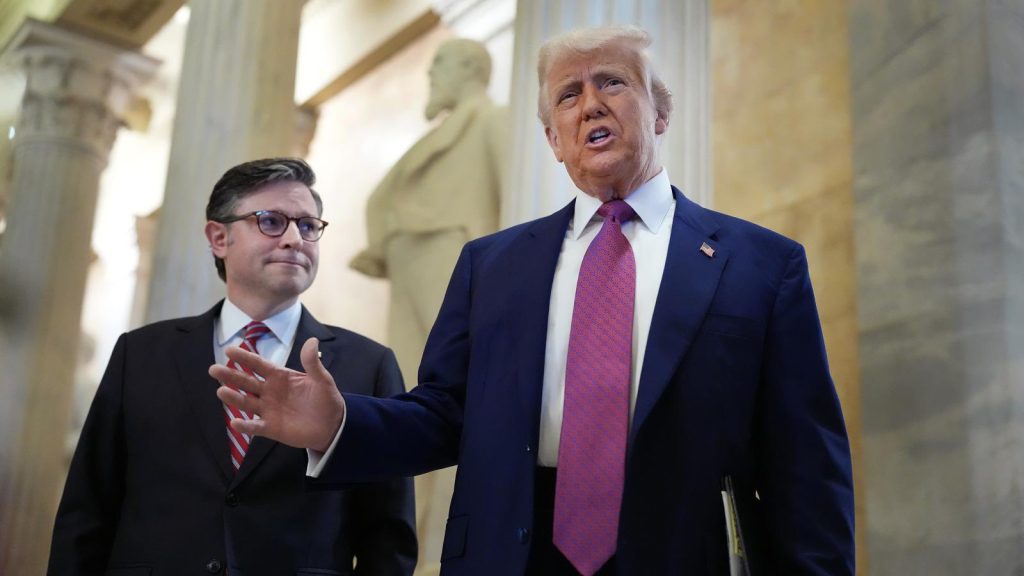
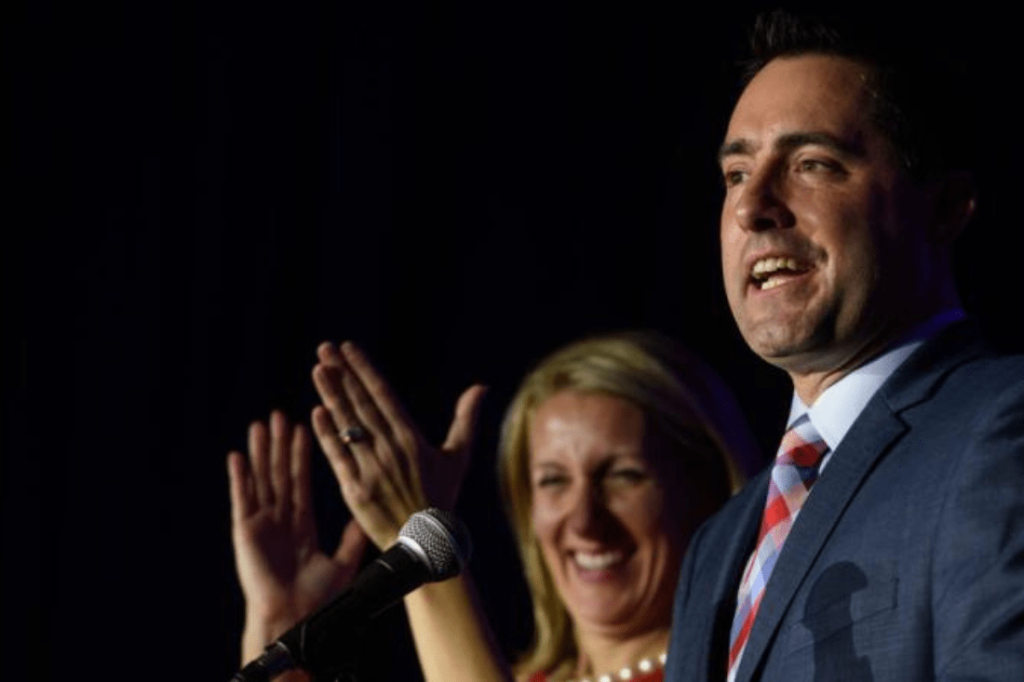
Articles / Elections / Politics & Policy White House’s full-bore approach spreads to state redistricting efforts The efforts by states to redraw congressional district lines came to a head this summer during Texas’ fight that could result in five blue-leaning seats turning red. By: President Donald Trump’s aggressive governing style has made its way into state legislatures as they navigate the challenges of redistricting in their own states. Indiana is the latest state to examine its U.S. congressional district lines, aided by both Trump and Vice President JD Vance. As the battle over congressional districts is spreading across the country, red states like Indiana are looking at the way blue states have gerrymandered and believe they are not playing the same game with the same rules. “The rules are laid out a certain way, and we play by the rules. It works if all the other teams are playing by the same rules,” but if not, it’s an uneven playing field, according to Indiana Lieutenant Governor Micah Beckwith. “States like Massachusetts are a good parallel to Indiana, because we’re about the same population. We both have nine congressional seats. They’ve got about 30% Republican out in Massachusetts. We have about 30% Democrats here in Indiana, but Massachusetts has zero Republican representatives out there,” Beckwith told Furthermore with Amanda Head Podcast. “States like Illinois, California and Massachusetts are stealing our votes in Washington. I wish we could play fair, but they’re the ones who are not. So until we fight back, we’re never going to be able to have our fair voice represented in Washington.” Throughout Trump’s campaigning last year and his second term thus far, his aggressive maneuvering has enabled a number of successes, like the One Big Beautiful Bill Act and sweeping deportation efforts. That level of savagery seems to be evident in the results Beckwith hopes to see in his own state. “We have seven Republicans and two Democrats and we’re going for nine-zero,” Beckwith told Furthermore with Amanda Head Podcast. Indiana’s current congressional map contains seven Republican districts and two Democratic districts. District one, represented by Democrat Rep. Frank Mrvan, is in the northwest corner of the state, miles from Chicago’s city center. District seven in the middle of the state, surrounding Indianapolis, is also represented by a Democrat, Rep. André Carson. In October, Vance traveled to Indianapolis to privately encourage Indiana Republican legislators to support the redistricting efforts, which would inevitably add more safe GOP seats before the 2026 elections. Joined by Senator Jim Banks, R-Ind., Vance pressed the case alongside Trump, who made conference calls with Republican legislators in the state. The fight is ongoing, according to Beckwith. He told Just The News that supporters of the effort have managed to whip 21 or 22 votes, but that’s a few votes short of the 25 vote threshold, with Beckwith serving as the tie-breaking vote. Beckwith indicated that a secret vote was held in the Senate earlier this week. President Pro Tempore of the Indiana Senate, Rodric Bray, then reported that they did not have the votes to pass the measure and forewent holding an on-the-record vote. But Beckwith argues that a public vote might pass when Indianans are allowed to know how their representatives are voting. “It’s a huge slap in the face to the people of Indiana, because you’re not respecting the Constitution and the constitutional authority that the governor has to call a special session.” “There’s at least three or four that would come over if they had to put their name next to a public vote. That’s the thing that’s so shady. How do we know that these senators, if they had to come out publicly for it, wouldn’t change their tune?” Bray effectively ended the effort by saying his chamber does not have enough votes for its passage. Earlier this week, POLITICO reported that Trump invited Bray and others to a face-to-face Oval Office meeting as early as this week – in an attempt to convince them to join his redistricting effort to give the GOP an advantage in the midterm elections. Roughly 20 other states are adopting new maps or are in the process of arguing for measures to redistrict: California, Missouri, North Carolina, Ohio, Utah and Texas have approved new maps, though Utah’s and Texas’ are currently being litigated. Florida, Maryland, Virginia, Illinois, Kansas, and Nebraska are all exploring official actions, or are in the process of forming commissions to examine the issues. Alabama, Connecticut, Georgia, Louisiana, New York and Wisconsin are enduring pending litigation in their redistricting battles. This summer, all eyes were on Texas as lawmakers initiated a mid-decade congressional redistricting process following a U.S. Department of Justice letter citing concerns over racial gerrymandering in four majority-minority districts. With support from Trump to redraw boundaries, the new maps, approved by the state legislature in August and signed by Governor Greg Abbott, were designed to shift up to five Democratic-held districts toward Republican advantage, particularly in areas like Houston and Dallas. However, on Tuesday, a federal three-judge panel ruled the maps unconstitutional due to racial gerrymandering, and ordered the state to use the 2021 boundaries for the 2026 elections. An appeal to the U.S. Supreme Court is sure to come. Amanda Head of Just The News reached out to Senator Bray’s office for comment but has not heard back. TOP STORIES White House’s full-bore approach spreads to state redistricting efforts Americans still have Bidenflation blues, despite economic improvements going into the holidays Alarming number of Americans, Democrats expect a politically violent future White House trying to sort out what Biden and Blinken ignored in Nigerian war on Christians In off-year elections, Republicans ignored major Trump wins that could’ve changed the night LATEST EPISODES Lt. Gov. Beckwith: Senators defying Gov Braun’s special session is a ‘slap in the face’ to Hoosiers & POTUS Can Virginia limit teens’ social media use? NetChoice argues new law violates First Amendment rights Moms for Liberty CEO: Saving America starts with saving our school aged children from indoctrination Texas Land Commissioner Dawn Buckingham is one step ahead, waging new underground war against the cartels Trump


Articles, Energy, Politics & Policy

EPA chief says ‘the sky is the limit’ with Trump’s diplomatic deals on strategic minerals

Articles / Energy / Politics & Policy EPA chief says ‘the sky is the limit’ with Trump’s diplomatic deals on strategic minerals Trump spent the last week making a strategic push to diversify and secure global supply chains for rare earths and essential strategic resources away from China’s near-monopoly, reducing America’s reliance on Chinese resources for defense and electronics. By: Following the signing of five critical mineral deals over the course of President Donald Trump’s first nine months in office with Australia, Japan, Malaysia, Thailand and Cambodia, Environmental Protection Agency (EPA) Administrator Lee Zeldin says that the need to push for further deals will not cease and that “the sky is the limit.” “We can’t just double what we’ve done so far and at some point in the future be satisfied with it. We always need to be pushing even further. And we have so much of these rare earth minerals in our own ground, we need to not only be tapping into the supply, but also boosting the entire supply and supply chain process,” he told Just The News. China and the ethical question of dealing with the CCP In a broad interview Tuesday with Just The News, Zeldin discussed the importance of the United State’s access to these minerals. “It’s important for our national security, for our economy. It’s also better for our environment too, because we tap into the supplies so much better and safer than so many other countries around the world. So this is a big deal.” Zeldin referenced the ethical issues surrounding the mining of resources in countries like China, which has long been known to utilize child and forced labor and abhorrent working conditions. In Xinjiang, over one million Uyghurs and other Turkic Muslims have been detained in internment camps and coerced into labor-intensive jobs in sectors like cotton harvesting, aluminum production, and manufacturing, often under threat of detention or family separation. In a Southeast Asia critical minerals blitz, Trump secured deals all over the region. During Trump’s state visit to Japan on Tuesday, Trump and Japanese Prime Minister Sanae Takaichi formalized a strategic partnership in Tokyo focused on bolstering the extraction and refinement of vital minerals and rare earth elements to reduce reliance on China’s dominant supply networks. Under the agreement, both nations will synchronize funding efforts, expedite regulatory approvals, and create a joint emergency task force to counter disruptions, with Japan committing as much as $400 billion toward American initiatives in minerals, energy infrastructure, and artificial intelligence. Asian alliances used for diplomatic assistance, leverage Prior to Trump’s Japan trip on Monday, Trump and Malaysian Prime Minister Anwar Ibrahim signed a Memorandum of Understanding in Kuala Lumpur during the ASEAN (Association of Southeast Asian Nations) Summit, committing to collaborate on exploration, extraction, processing, and recycling of critical minerals like rare earths to diversify supply chains away from China’s dominance. The pact also includes Malaysia’s pledge not to impose export bans or quotas on these minerals to the U.S., fostering joint investments and partnerships between American and Malaysian firms to bolster global supply resilience amid Beijing’s tightening controls. Cambodia was one of the partners in Sunday’s critical minerals deal, where Trump signed a reciprocal trade agreement with Cambodian Prime Minister Hun Manet on the sidelines of the ASEAN Summit. The deal commits Cambodia to reducing tariff and non-tariff barriers, protecting labor rights, and strengthening environmental standards in mineral processing and exports, while granting U.S. firms preferential access to Cambodian resources for diversification of global supply chains. Also on Sunday, Trump met with Thai Prime Minister Anutin Charnvirakul to sign a Memorandum of Understanding, took a whole-of-supply-chain approach to critical mineral cooperation through joint exploration, extraction, processing, refining, and recycling to counter China’s dominance. The agreement prioritizes partnerships between U.S. and Thai companies, promotes investments in value-added domestic industries over raw exports, and grants both nations priority access to critical minerals assets, while committing Thailand to enhanced labor rights and environmental standards. Zeldin: Trump will “just keep pushing no matter what.” Last week, Trump also struck a deal with Australian Prime Minister Anthony Albanese for a landmark Critical Minerals Framework designed to fast-track collaborative investments in rare earth mining and processing to challenge China’s stranglehold on worldwide supplies. The pact secures more than $3 billion in upfront government financing from each nation for initiatives potentially unlocking $53 billion in resources, featuring American backing for a cutting-edge gallium refinery in Western Australia and expedited approvals to ramp up output within 12 months. Highlighting what the future could hold for America’s access to these critical supplies, Zeldin said, “I would say that we’re making leaps into and through this golden age for America. But I wouldn’t say that President Trump would ever be happy just by doubling what he’s done so far, he’s going to just keep pushing no matter what.” TOP STORIES In off-year elections, Republicans ignored major Trump wins that could’ve changed the night EPA chief says ‘the sky is the limit’ with Trump’s diplomatic deals on strategic minerals ‘No Kings’ protesters silent when Democrats rule as monarch Democrats panic over redistricting numbers with pivotal SCOTUS decision looming DOGE says that it has created $210 billion in taxpayer savings LATEST EPISODES Alfredo Ortiz: ‘If we can’t band together over key Main Street issues, we face a blue wave next year’ Housing First, Results Last: Why California’s Homelessness Crisis Keeps Growing Mark Finchem reacts to being named in Arctic Frost: ‘wanting fair elections made me a nat’l security threat?’ Restoring the American Dream: Property Rights, Home Buying & the Fight for Affordable Housing Making Bold Things Happen: From Pittsburgh to Philadelphia & beyond, Steve Rosenberg combats antisemitism RELATED ARTICLES In off-year elections, Republicans ignored major Trump wins that could’ve changed the night EPA chief says ‘the sky is the limit’ with Trump’s diplomatic deals on strategic minerals ‘No Kings’ protesters silent when Democrats rule as monarch Democrats panic over redistricting numbers with pivotal SCOTUS decision looming DOGE says that it has created $210 billion in taxpayer savings Top White House official hints Antifa could soon be designated foreign terror group: ‘Stay tuned’

Articles, Health, Politics & Policy

SNAP program rife with fraud, disparity and health issues for participants, government agencies say

Articles / Health / Politics & Policy SNAP program rife with fraud, disparity and health issues for participants, government agencies say In the first quarter of 2024, nearly 177,000 fraud incidents were reported. The CDC noted that 2024-2025 data found that SNAP recipients continue to face disproportionately high rates of obesity and diabetes, particularly in low-income areas where participation exceeds 20% of households. By: The November 1 deadline looms as SNAP (Supplemental Nutrition Assistance Program) benefits are set to expire for roughly 42 million Americans. However, issues throughout the program have emerged and perhaps spurred by a tranche of viral videos — of uncertain origin — on social media, questions are being raised about how much of the program’s benefits go to those who truly need it. Pew Foundation’s numbers A Pew Research study published in 2023 found that in fiscal year 2021, approximately 41.5 million people, or 12.5% of the U.S. population, participated in the SNAP, down from a peak of 47.6 million in 2013. The program reached 22.9 million households, representing 17.3% of all U.S. households, with significant involvement of vulnerable groups. Nearly 17 million children (23% of all U.S. children), 9.4 million working-age adults with disabilities, and members of households with elderly individuals were among the participants. About 36% of SNAP households lived below the poverty line in 2021, with an average monthly benefit of $231 per person or $427 per household. Racially, 39% of participants were White, 26% Black, and 17% Hispanic (of any race), though participation rates were higher among Black (27%) and Hispanic (23%) individuals compared to Whites (8%). These figures highlight both the economic hardship addressed by SNAP and the program’s disproportionate role in supporting communities of color. Fraud throughout the program amounts to billions In fiscal year 2023, the U.S. Department of Agriculture estimated that 11.7 percent of SNAP benefits, amounting to approximately $10.5 billion, were paid out improperly, with fraud contributing to a portion of these losses through recipient and retailer violations. Every dollar of SNAP benefits lost to fraud generates an additional $3.72 in costs for agencies, primarily from identity fraud, account takeovers, eligibility misrepresentation, and EBT card trafficking. In the first quarter of 2024 alone, nearly 177,000 fraud incidents were reported across 46 states, with New York experiencing over 16,000 cases, often involving EBT card skimming and cloning. Despite a 350 percent increase in federal spending on retailer integrity and anti-trafficking efforts from 2012 to 2023, SNAP overpayment errors surged to over 10 percent by 2023, highlighting persistent challenges in curbing benefit fraud. State efforts to improve SNAP SNAP is a federal program funded entirely by the U.S. Department of Agriculture (USDA) through the Food and Nutrition Service (FNS) However, administration of the program falls to the states even down to the local level, handling tasks such as determining eligibility, issuing benefits via EBT cards, processing applications, and conducting quality control reviews. The federal government sets the core rules, benefit levels, and funding, while states have flexibility in certain administrative procedures and may cover part of the administrative costs (typically split 50/50 with the federal government). This shared structure means that while fraud prevention policies are federally guided, states are primarily responsible for detecting, investigating, and addressing recipient and retailer fraud within their jurisdictions. Several states have successfully obtained USDA waivers to restrict the use of SNAP benefits for purchasing sugary drinks and candy, with Nebraska becoming the first, in May 2025, to ban soda and energy drinks, followed by approvals for Iowa, Indiana, and others that also prohibit candy and similar non-nutritious items. As of August 2025, a total of 12 states — including Arkansas, Idaho, Florida, Texas and West Virginia — have implemented or are set to implement these restrictions starting in 2026, aiming to promote healthier food choices amid concerns over chronic diseases like diabetes. SNAP doesn’t come without health issues  CDC (Centers for Disease Control) and U.S. Census Bureau data from 2024-2025 found that SNAP recipients continue to face disproportionately high rates of obesity and diabetes, particularly in low-income areas where participation exceeds 20% of households. For instance, in Staten Island’s highest-SNAP zip codes, obesity rates reach 35-40% and diabetes prevalence 14-18%, compared to borough-wide averages of 28% and 10%, respectively, illustrating how food insecurity amplifies these chronic conditions. The 2025 State of Obesity Report, drawing on 2024 CDC data, highlights that while overall adult obesity dipped slightly to 41.1% nationally, low-income groups reliant on SNAP programs like those in 19 states with rates over 35% bear the brunt, with calls for enhanced nutritional incentives to curb diabetes risks. Additionally, a 2023 NHANES analysis of low-income adults with type 2 diabetes (many SNAP-eligible) shows 63.4% obesity prevalence and 55% poor glycemic control, underscoring persistent links between program participation, socioeconomic stressors, and metabolic health disparities. Social stigma no more During the paper food stamp era, users reported enduring embarrassment at grocery checkouts, where clerks handled and sorted distinctive coupons in front of other shoppers, creating a sense of shame that kept many eligible people from signing up. Switching to EBT cards—indistinguishable from ordinary debit or credit cards and processed with a simple swipe—removed all outward signs of SNAP use, sparing recipients from judgment reportedly associated with food stamp use. Studies show this loss of visible stigma played a major role in the program’s rapid expansion, pushing average monthly participation from roughly 17 million in 2000 to more than 42 million by 2023. TOP STORIES In off-year elections, Republicans ignored major Trump wins that could’ve changed the night EPA chief says ‘the sky is the limit’ with Trump’s diplomatic deals on strategic minerals SNAP program rife with fraud, disparity and health issues for participants, government agencies say ‘No Kings’ protesters silent when Democrats rule as monarch Democrats panic over redistricting numbers with pivotal SCOTUS decision looming LATEST EPISODES Alfredo Ortiz: ‘If we can’t band together over key Main Street issues, we face a blue wave next year’ Housing First, Results Last: Why California’s Homelessness Crisis Keeps Growing Mark Finchem reacts to being named in Arctic Frost: ‘wanting fair elections made me a nat’l security threat?’ Restoring the American Dream: Property Rights,

America, Articles, Elections, Politics & Policy

Democrats panic over redistricting numbers with pivotal SCOTUS decision looming

Episodes Democrats panic over redistricting numbers with pivotal SCOTUS decision looming If all states redistrict to the extent allowable, Republicans stand to gain more than Democrats. By: Lawyers involved in a consequential case on election redistricting re-argued Louisiana v. Callais on Wednesday before the Supreme Court, whose ruling could set a landmark precedent for other states performing redistricting operations. Democrats and media organizations are using phrases like “gutting voting rights” to refer to the possible outcome of reshaping the application of the Voting Rights Act nationwide. The stakes of the case “are only heightened by the backdrop of this national gerrymandering crisis,” former Democratic Attorney General Eric Holder, who leads Democrats’ main redistricting arm, said ahead of the high court hearing, according to Politico “We’ve been in redistricting battles for a very long time,” Louisiana Attorney General Liz Murrill told Just The News earlier this week. “And you know, most recently, we drew a map that the courts basically directed us to draw, reluctantly. We had been saying we didn’t think we could do this in a constitutional way. And they said, ‘Do it anyway.’” The landmark case, which was consolidated with Robinson v. Callais, challenges the constitutionality of Louisiana’s congressional redistricting map enacted as Senate Bill 8 following the 2020 Census. The map created a second majority-Black congressional district to comply with Section 2 of the Voting Rights Act, which prohibits racial discrimination in voting, but it faced lawsuits alleging unconstitutional racial gerrymandering under the Fourteenth Amendment. In January 2024, the Louisiana Legislature approved the new map during a special session to address prior court orders requiring fair representation for Black voters, who comprise about one-third of the state’s population. A three-judge federal district court panel ruled 2-1 in May 2024 that race had predominated in drawing the districts and blocked the map’s use, prompting direct appeals to the Supreme Court. Reality appears to be setting in for Democrats that when redistricting (or “gerrymandering” when it’s on the opposing side) is maxed out, Republicans gain more seats, some publications and networks are spiking the decibels of the alarm bells. “As I sat and listened to today’s oral arguments in Louisiana v. Callais, I was reminded of just how much is at stake in our country’s democracy,” said Louisiana Democrat Rep. Cleo Fields. “This case marks a pivotal moment in not only Louisiana’s ongoing fight to protect fair representation, but states all across this nation as well. While I am cautiously optimistic following this morning’s hearing, we must remain vigilant and committed to defending the principles enshrined in Section 2 of the Voting Rights Act of 1965.” Axios ran the Wednesday morning headline, “Louisiana’s Supreme Court case could gut Voting Rights Act,” fearmongering that “the case could end the legal basis minority voters use when challenging maps that dilute their political influence” and that it “could leave many places in the country without a remedy, even in extreme cases of racial discrimination and racial vote dilution,” according to Stuart Naifeh of the NAACP’s Legal Defense Fund. CNN on Wednesday discussed Democrats falling behind and warned its audience, “You go along in the states, Democrats run out of room. Republicans are able to gain plus seven House seats. That does not even take into account the potential gutting of the VRA before the Supreme Court.” The Supreme Court, weighted 6-3 conservative, opened with Chief Justice John Roberts expressing frank skepticism. He began the hearing by questioning the applicability of the Court’s 2023 Allen v. Milligan decision (a 5-4 ruling upholding VRA redistricting claims in Alabama, which he authored). He downplayed its precedent, noting it “took the existing precedent as a given” and subtly critiqued ongoing race-focused remedies as potentially indefinite, an argument that Justice Brett Kavanaugh also raised. Kavanaugh, whose swing vote upheld the VRA in 2023 (with a concurrence calling for temporal boundaries), pressed attorneys on whether race-based remedies should “carry on indefinitely.” He likened it to the Court’s 2023 affirmative action ban, suggesting perpetual racial considerations undermine equal protection. This hints at his potential shift, which could flip the 2023 outcome. TOP STORIES DOGE says that it has created $210 billion in taxpayer savings Top White House official hints Antifa could soon be designated foreign terror group: ‘Stay tuned’ Despite appearances, the NFL still pays lip service to ‘woke’ crowd WH Press Secretary Leavitt says Democrats’ language attacking ICE is ‘despicable’ How Trump can navigate budget negotiations to avert government shutdown LATEST EPISODES Democrats panic over redistricting numbers with pivotal SCOTUS decision looming Inside Operation Summer Heat: FBI Director Kash Patel on Crime, Counterintelligence & Accountability DOJ vs. Gun Owners: Why AG Pam Bondi Must Stop Fighting the Second Amendment From Columbus to Trump: How America’s Heritage Fuels Newfound Patriotism Virginia Lt. Gov. GOP Nominee: Jay Jones ‘revealed the violence problem that’s prevalent in Democrat Party’ RELATED ARTICLES DOGE says that it has created $210 billion in taxpayer savings Top White House official hints Antifa could soon be designated foreign terror group: ‘Stay tuned’ Despite appearances, the NFL still pays lip service to ‘woke’ crowd WH Press Secretary Leavitt says Democrats’ language attacking ICE is ‘despicable’ How Trump can navigate budget negotiations to avert government shutdown Convention of States effort surges as Trump aims at shrinking size, scope of federal government Fed rate cut makes minimal immediate impact, but long-term effects in question Trump visits a U.K. facing internal social, political turmoil with message of freedom, friendship Trump Agriculture Department funds Farm-to-School program at historic levels Ignored by media, enabled by Dems: how soft-on-crime policies unleashed murder of Ukrainian refugee

Elections, Politics & Policy

‘Charlie Kirk effect’ in full force as voters register Republican in large numbers

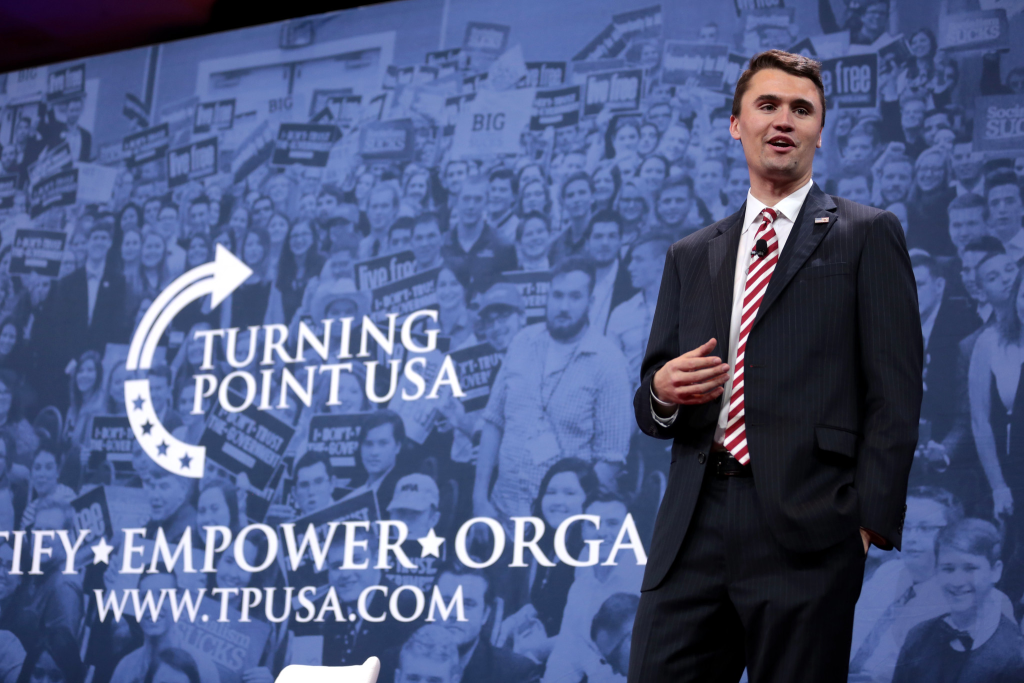
Elections / Politics & Policy ‘Charlie Kirk effect’ in full force as voters register Republican in large numbers The surge in GOP voter registrations strengthens Republican momentum in key swing states ahead of the 2026 midterms. By: On Sunday, as tens of thousands of mourners filled State Farm Arena in Glendale, Arizona, for a memorial service for Turning Point USA founder Charlie Kirk, voter registration tables at the event were inundated with future voters. The massive event doubled as a tribute to Kirk’s lifelong focus on conservative activism and youth outreach. In line with his legacy, voter registration booths staffed by Turning Point volunteers were set up inside the stadium, drawing significant participation. 200,000 to 300,000 attendees, many register to vote Turning Point USA has not published official voter registration data. However, approximately 200,000 people registered for tickets for the memorial in advance and estimates report that there were 200,000 to 300,000 with overflow. On-site law enforcement corroborated these estimates. Given the scale of attendance, that could translate to thousands of new registrations, given the crowd size and focus on unregistered conservatives (roughly 30% of U.S. Christians are unregistered, a group Kirk spent significant time and treasure to engage). Recent data show GOP voter registration gains in key states like Pennsylvania, where Republicans clocked in at +3,022 net in the days following Kirk’s assassination (week ending September 22). This included 1,756 Democrat-to-Republican switches. Additionally, North Carolina and Arizona both outpaced prior months and linked the surge directly to the assassination and memorial. The “Charlie Kirk Effect” Matt Margolis of PJ Media remarked that “Some on the left celebrated the attack.” That reaction has now triggered what’s being called the “Charlie Kirk effect,” a historic wave of Democrats abandoning their party and joining the GOP. On Sunday, Kirk’s wife, Erika, publicly forgave her husband’s alleged killer. By contrast, House Minority Leader Hakeem Jeffries, D-N.Y., told CNN viewers that if his party regains power, they will use the government to go after anybody “doing the bidding of the Trump administration.” Democrats losing on the economy, immigration and crime CNN’s Chief Data Analyst Harry Enten broke down numbers from a new Washington Post/IPSOS poll showing that Democrats are underwater on three major issues: the economy, immigration and crime. When asked which party is trusted more on the economy, Republicans had a seven-point lead. On immigration, an issue for which Democrats have demonized the Trump administration, Republicans are up by 13 points. California’s Democratic Speaker of the California State Assembly recently referred to ICE agents as “secret police.” As for crime, blue-city mayors and sanctuary state governors are under investigation for allegedly trying to falsify crime data in opposition to Trump’s utilizing the National Guard in several cities. Independent voters are tilting to GOP as well Independents in the poll favored Republicans by one point on the economy, ten points on immigration and 21 points on crime. He also reflected on the same poll leading into the 2022 midterm elections, which resulted in a 12-point lead on the economy for Republicans, a three-point lead for Republicans on immigration. On crime, Republicans saw a 13-point lead. “At this particular point, the ball may be on the ground, but the Democrats have not picked up the ball and run with it. If anything at this particular point, it’s the Republicans who are running with the ball on the top issues of the economy, immigration and crime,” Enten said. TOP STORIES ‘Charlie Kirk effect’ in full force as voters register Republican in large numbers Convention of States effort surges as Trump aims at shrinking size, scope of federal government Fed rate cut makes minimal immediate impact, but long-term effects in question Trump visits a U.K. facing internal social, political turmoil with message of freedom, friendship Trump Agriculture Department funds Farm-to-School program at historic levels LATEST EPISODES Pregnant women should be trusted to make decisions, don’t need noble lies from gov’t or maker of Tylenol New Film Friday: Conflict & the Battle for Israel, Dinesh D’Souza unveils “The Dragon’s Prophecy” Tylenol risks, ICE shooting & Bolton’s Classified Case: Just The News reporters present today’s headlines Congressman Fine celebrates Trump’s tariff triumphs, also says “we’ve got a Muslim problem in America” From Jimmy Kimmel to Charlie Kirk: This episode exposes double standards & political persecution RELATED ARTICLES Convention of States effort surges as Trump aims at shrinking size, scope of federal government Fed rate cut makes minimal immediate impact, but long-term effects in question Trump visits a U.K. facing internal social, political turmoil with message of freedom, friendship Trump Agriculture Department funds Farm-to-School program at historic levels Ignored by media, enabled by Dems: how soft-on-crime policies unleashed murder of Ukrainian refugee Trump administration wants to revolutionize AI’s integration into education with ‘watchful guidance’ Illinois State House Minority Leader: Chicagoans are crying for help Trump strikes skeptical tone on his own Covid vaccine record, policies Trump may be reassembling the way college athletes do — or don’t — get paid Trump’s executive order to protect the U.S. flag hits at heart of culture

Articles, Politics & Policy

Convention of States effort surges as Trump aims at shrinking size, scope of federal government

Articles / Politics & Policy Convention of States effort surges as Trump aims at shrinking size, scope of federal government The Convention of States would allow states to propose constitutional amendments to limit federal power, potentially reshaping the balance of governance in the U.S. By: The Convention of States (COS) Action hosted its annual national conference this weekend in Indianapolis, as calls to rein in expansive federal spending, term limits and the power of the federal government have not subsided, despite President Donald Trump’s mandate to do so. The Convention of States, driven by Citizens for Self-Governance, is a grassroots effort to utilize Article V of the U.S. Constitution to convene a limited state convention. It enables delegates to propose amendments targeting federal fiscal restraint, reduced government authority, and term limits for Congress and officials. Meckler: “The future of the country is at stake” To initiate the convention, 34 states (two-thirds) must pass resolutions. Any proposed amendments during the convention would require ratification by 38 states (three-fourths) to become law, which supporters claim is the stop-gap preventing what critics warn could devolve into a “runaway convention.” Nineteen states to date have passed the Convention of States Article V application, with an additional eight states granting passage in one chamber but not yet the other. All 50 states are actively considering the Convention of States Resolution. Just The News spoke to Mark Meckler, president of COS, about the gravity of their efforts in 2025. “I think the future of the country is at stake. I don’t think that’s an overstatement. Elections are always critically important, and every election is the most important election of our lifetime. There’s also a fundamental structural reform that has to take place at the level of the federal government that will never be done in Washington, DC.” The Article V convention process has never been utilized in U.S. history, with all 27 constitutional amendments originating from Congress. Supporters claim it enables states to curb federal overreach independently, while opponents warn that it might exceed its intended scope, despite protections like focused agendas and a separate ratification process. Regardless of which party has power of the executive in the Oval Office, that party tends to suffer complacency in galvanizing supporters on even their most popular issues. When asked if this had been a problem for COS, Meckler said that while that premise was true for Trump’s first term in office, it’s not the case now. “The reason is, people lived through four years of the Biden administration. They saw how he wiped out most of what President Trump did with the swipe of a pen and executive orders, and they’re worried about that happening again.” To the contrary, he added. it has not had a “calming effect,” rather, “I would say people are fired up because they see President Trump actually aggressively engaged in doing so much that they believe that we can do even more.” National debt, term limits could be affected Supporters of COS who are clamoring about out-of-control spending may have a substantial case. The U.S. national debt in the year 2000, according to the U.S. Treasury, was $5.63 trillion. It is now $37.43 and counting. That’s a 565% increase. Another hallmark issue for COS is term limits for elected officials. The call for term limits in elected office stems from bipartisan concerns about entrenched power, career politicians, and declining public trust in government. Supporters of the idea argue that term limits would promote fresh perspectives and accountability, since the average length of service is now 10.1 years for the House (a little over five terms) and 12.7 years for the Senate (over two terms.) De facto sinecures The official website of the House of Representatives shows that since Congress convened in 1789, 33 members have served 40 years or longer in the House of Representatives. The Senate Press Gallery reports that some Senators, such as Chuck Grassley, R-Iowa, have served since 1981. “We want to etch that in stone” Those pushing back against term limits counter that it could disrupt experience, institutional knowledge, and crucial legislation, potentially empowering unelected influencers like lobbyists. However, according to Meckler, term limits decrease the influence of lobbyists because their power is based on relationships built over time and when there’s a new batch of legislatures, the acquaintance process restarts. The resolution also calls for term limits on staffers and bureaucrats, reducing the influence of support staff lifers in the “deep state”. The COS process would take place autonomously and separate from both Congress and the White House. However, Meckler indicated that Trump can help send supporters their way. While presidents such as Washington, Lincoln and Reagan had all supported the Article 5 mechanism, no president has thrown his imprimatur behind the effort. Trump could change that. “There’s nobody more important and more appropriate to help lead the charge than President Trump,” Meckler said. If Trump does, says Meckler, “When we get to the Convention of States, we help to preserve the president’s legacy. A prime example is doing away with the Department of Education, which would be reversed immediately as soon as there is a Democrat administration. We want to be able to write that into the Constitution, that the federal government may not be involved in education. When we do that, we preserve his legacy. He’s the guy shutting down the Department of Education. We want to etch that in stone.” TOP STORIES Convention of States effort surges as Trump aims at shrinking size, scope of federal government Fed rate cut makes minimal immediate impact, but long-term effects in question Trump visits a U.K. facing internal social, political turmoil with message of freedom, friendship Trump Agriculture Department funds Farm-to-School program at historic levels Ignored by media, enabled by Dems: how soft-on-crime policies unleashed murder of Ukrainian refugee LATEST EPISODES Pregnant women should be trusted to make decisions, don’t need noble lies from gov’t or maker of Tylenol New Film Friday: Conflict & the Battle for Israel, Dinesh D’Souza unveils “The Dragon’s Prophecy” Tylenol risks, ICE shooting & Bolton’s Classified Case:

Articles, Health, Politics & Policy

Trump Agriculture Department funds Farm-to-School program at historic levels

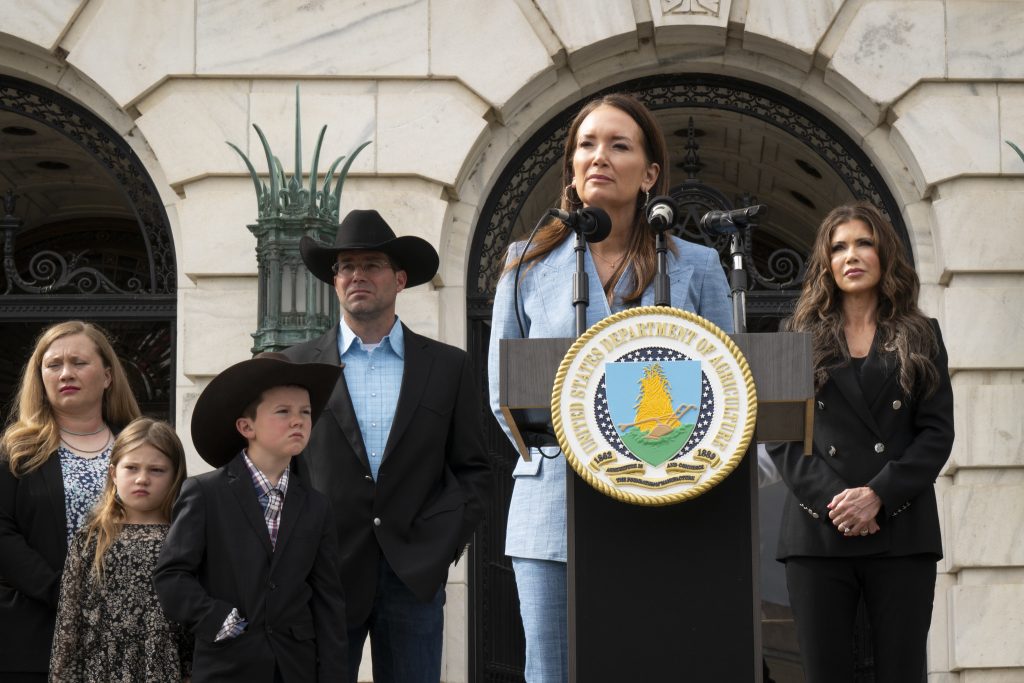
Articles / Health / Politics & Policy Trump Agriculture Department funds Farm-to-School program at historic levels The funding injection helps increase access to non-processed foods free from chemicals and helps children learn more about farming and agriculture. By: The United States Department of Agriculture (USDA) is planning on providing an additional $18 million in grants to schools who want to participate in the Patrick Leahy Farm to School Grant Program, nearly 20% of the entire funding allotted over the 12-year life of the program. The Patrick Leahy Farm to School Grant Program, managed by the USDA’s Food and Nutrition Service, promotes the inclusion of local foods, agricultural education, and nutrition-focused activities in schools across the country. Since its inception in 2013, it has distributed $100 million to support over 1,275 initiatives, increasing students’ access to fresh, local produce while building ties to regional agriculture. Child nutrition, community food networks Aligning with the Make America Healthy Again’s (MAHA) efforts to move away from processed foods, the program funds efforts such as school gardens, farm field trips, and local food sourcing to enhance child nutrition and bolster community food networks. The program also incorporates education in food safety, summer programs, and farm-to-school initiatives in tribal communities. The USDA’s Wednesday announcement confirms that the 2026 investment represents the “largest total amount” the department has offered in a single year. On Tuesday, Health and Human Services (HHS) Secretary Robert F. Kennedy Jr. released over 100 recommendations in his “Make Our Children Healthy Again” strategy report. The report addresses some of the most pressing health issues facing children in the United States, such as poor diet, chemical exposure, lack of physical activity and chronic stress, and overmedicalization. Roughly 60% of the typical U.S. diet is made up of ultra-processed foods, packed with added sugars, salt, and unhealthy fats, fueling obesity and chronic illnesses. Research indicates a global rise in ultra-processed food consumption by 5-10% over the last 20 years, especially in low- and middle-income nations. These nutrient-poor foods contribute to nearly 90% of added sugar consumption in the U.S., increasing risks of diabetes and cardiovascular issues. One in five American kids suffer from obesity In the United States, the CDC reports that approximately one in five children and adolescents aged 2 to 19 years—equating to about 14.7 million individuals—suffer from obesity, with prevalence rates reaching 19.7% overall based on data from 2017 to 2020, and showing higher rates among adolescents at 22.2%. This contributes significantly to chronic diseases, as childhood obesity triples the risk of developing type 2 diabetes, hypertension, cardiovascular issues, and even certain cancers like breast and colon in later life, while also elevating markers of chronic inflammation as early as age three. Economically, the burden is substantial, with annual medical costs for obesity among U.S. children totaling $1.3 billion in 2019 dollars, or $116 more per child per year compared to those at a healthy weight. The announcement touted a number of additions and improvements. A streamlined application process should simplify requirements to take part in the program, reduce barriers for applicants and encourage more innovation and partnerships. Despite misinformation, the program is growing The program will also broaden eligibility to include state and local agencies, tribal organizations, more schools and child nutrition programs, nonprofits and more agricultural producers. Access is also expanded to include all child nutrition programs like summer educational programs and child care. Grants range from $100,000 to $500,000 per project. The program has been needing an overhaul. A recent USDA survey found that while nearly half of Iowa’s school districts offer classroom agriculture programs, only about 15% maintain edible school gardens. By supporting such initiatives, the program strives to spark interest in farming among students while boosting rural economies. Previous grants have facilitated nearly $790 million in local food purchases by schools in a single year, providing direct economic benefits to farmers and producers. In March of this year, Democratic politicians and their associates in the left-leaning media blared headlines saying “USDA yanks $3.4M in aid to state food banks,” “Jackson Food Program Disrupted as USDA Cancels Farm-to-School Grant,” and “Schools and farmers left scrambling after USDA axes $100 million program.” In fact, the program was not canceled. Buried at the end of a story calling the program “canceled,” a USDA spokesperson told Little Rock Public Radio in March that the program was not canceled, but “paused” pending review, and that the Trump administration is “making plans for a new funding opportunity in FY26.” Six months later, those plans have arrived. TOP STORIES Trump Agriculture Department funds Farm-to-School program at historic levels Trump administration wants to revolutionize AI’s integration into education with ‘watchful guidance’ Illinois State House Minority Leader: Chicagoans are crying for help Trump strikes skeptical tone on his own Covid vaccine record, policies Trump may be reassembling the way college athletes do — or don’t — get paid LATEST EPISODES Dr. Ben Carson serves on Trump’s Religious Liberty Commission, talks about the need for faith in America Ex-Border Union Boss applauds SCOTUS decision on LA ICE raids, says next phase is ‘targeted enforcement’ The AI revolution led by Trump: Teacher Unions fear losing control, parents continue fight for education freedom IL GOP Leader McCombie blasts Gov. Pritzker for deflecting to Trump while Chicago crime remains out-of-control Biden’s Retaliation Backfires: DOJ settles with FBI whistleblowers—major victory for Empower Oversight RELATED ARTICLES Trump Agriculture Department funds Farm-to-School program at historic levels Trump administration wants to revolutionize AI’s integration into education with ‘watchful guidance’ Illinois State House Minority Leader: Chicagoans are crying for help Trump strikes skeptical tone on his own Covid vaccine record, policies Trump may be reassembling the way college athletes do — or don’t — get paid Trump’s executive order to protect the U.S. flag hits at heart of culture Newsom targets Trump as proxy for potential 2028 GOP presidential candidates, nominee Cities across America would benefit from Trump’s D.C.-style takeover Trump to make upgrades to White House, the first of this century Trump 2.0 White House hones messaging to challenge false stories, engage pop culture

Articles, Education, Government, White House

Trump administration wants to revolutionize AI’s integration into education with ‘watchful guidance’

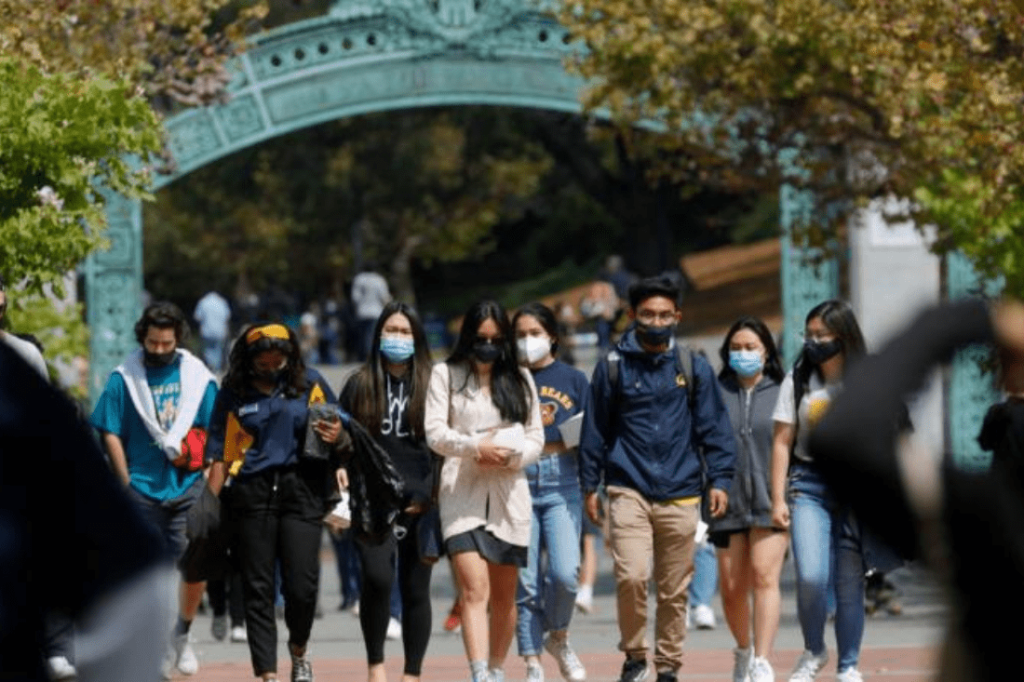
Articles / Education / Government / White House Trump administration wants to revolutionize AI’s integration into education with ‘watchful guidance’ The White House AI Education Task Force aims to equip American youth with the skills needed for an AI-driven future, fostering innovation and economic competitiveness through education reform and public-private collaboration. By: On Thursday, First Lady Melania Trump announced historic partnerships and initiatives to bring the power of artificial intelligence (AI) into the education space, revolutionizing the relationship between traditional education and the technology that many have worried will require aggressive oversight. She made it clear that that oversight, or “watchful guidance”, will be ever-present as parents navigate the world of AI that their children may be exploring while learning. Recognizing the dangers of allowing AI to flourish without boundaries, she warned, “During this primitive stage, it is our duty to treat AI as we would our own children — empowering, but with watchful guidance.” The second meeting of the White House Task Force on Artificial Intelligence Education was attended by cabinet members, educators and CEOs from companies like Microsoft, IBM and OpenAI, emphasizing the critical role of AI literacy in ensuring American competitiveness. AI without “totally subverting learning” Just The News spoke to author and school choice advocate Dr. Corey DeAngelis about the First Lady’s dedication to cautiously advancing the issue. “What she’s trying to do is get ahead of the curve on this issue of AI transforming our society. The cat’s out of the bag, and in order for our kids to be competitive on an international stage — other countries are already leveraging AI in the classroom — we need to be able to use it as a tool for good. We need to be able to implement it into our education system without totally subverting learning.” Traditionally, two concerns emerge about AI in education. AI often provides inaccurate or biased information — called “AI hallucinations” — which might mislead students if not carefully monitored. Massachussetts Institute of Technology‘s Sloan School of Management explains that “The technology behind generative AI tools isn’t designed to differentiate between what’s true and what’s not true. Even if generative AI models were trained solely on accurate data, their generative nature would mean they could still produce new, potentially inaccurate content by combining patterns in unexpected ways.” Additionally, over-reliance on AI tools could also weaken critical thinking and independent learning skills. DeAngelis spoke on those concerns and equated them to fears that with the advent of calculators, children would never learn to do math with paper and pencil. He said, “People have been fearful of different technologies over time, throughout history, and it’s those fears that have basically never come to fruition. So, if you think about the calculator, people thought that kids would never be able to learn how to do math.” The Presidential AI Challenge Historically, when new and groundbreaking technology emerges, it brings about cultural and economic pushback. DeAngelis continued, “Again, you think about the personal computer, you had similar concerns, but those tools have turned out to be a net benefit for humanity. It’s helped us become more productive, and so with AI in the classroom, I don’t want some one-size-fits-all solution from the government telling us how every single school should implement it.” Furthering on that principle and what DeAngelis refers to as a “1000 flowers blooming approach,” he talked about Trump’s Presidential AI Challenge, which was launched on August 26. The nationwide initiative is a competition to inspire K-12 students and to get educators excited about using AI to solve real issues in their own community. It’s part of an effort under Executive Order 14277 (signed by President Donald Trump in April) to boost AI education and keep the U.S. leading in tech innovation. Let parents in the free market decide One area where AI needs exposure is in the school choice arena, in which DeAngelis is an expert. “We need school choice in order to get it done the right way. You need the free market, the invisible hand figuring out this problem, because I don’t trust central planners and bureaucrats to figure it out. And private schools are already starting to implement artificial intelligence.” The private Alpha School in Austin, Texas, which charges about $40,000 tuition, is already implementing AI into their curriculum. According to DeAngelis, students are only in front of a computer about two hours per day, utilizing a guided curriculum tailored to each student that maximizes results in a shorter “classroom” period. The rest of the time is spent learning life-skills like public speaking, coding, entrepreneurship, and outdoor education. The Educational Choice for Children Act within the One Big Beautiful Bill Act is the first ever federal scholarship tax credit that will enable 85 to 90% of children in the nation to benefit from school choice scholarships. DeAngelis wants parents to be able to control what AI and to what degree that AI is being utilized in their child’s education. If implemented properly into school choice, he says, the controls will be similar to any other aspect of learning. “That’s how it works when you’re homeschooling, right? You have total control. I would recommend doing it that way. And you know if they don’t feel confident enough to do that yet, the decision-making level is at the provider level. So they can choose a microschool that uses more or less AI in the curriculum, or, if at all.” TOP STORIES Trump administration wants to revolutionize AI’s integration into education with ‘watchful guidance’ Illinois State House Minority Leader: Chicagoans are crying for help Trump strikes skeptical tone on his own Covid vaccine record, policies Trump may be reassembling the way college athletes do — or don’t — get paid Trump’s executive order to protect the U.S. flag hits at heart of culture LATEST EPISODES The AI revolution led by Trump: Teacher Unions fear losing control, parents continue fight for education freedom IL GOP Leader McCombie blasts Gov. Pritzker for deflecting to Trump while Chicago crime remains out-of-control Biden’s Retaliation Backfires: DOJ settles with FBI

Articles, Coronavirus, Government, Politics & Policy, White House

Trump strikes skeptical tone on his own Covid vaccine record, policies

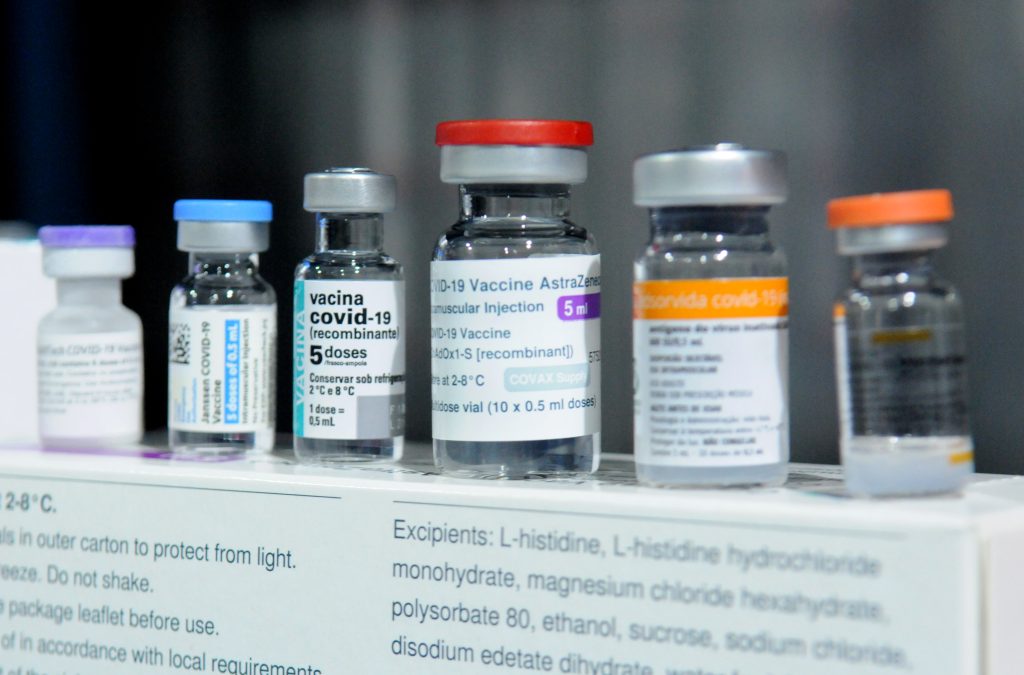
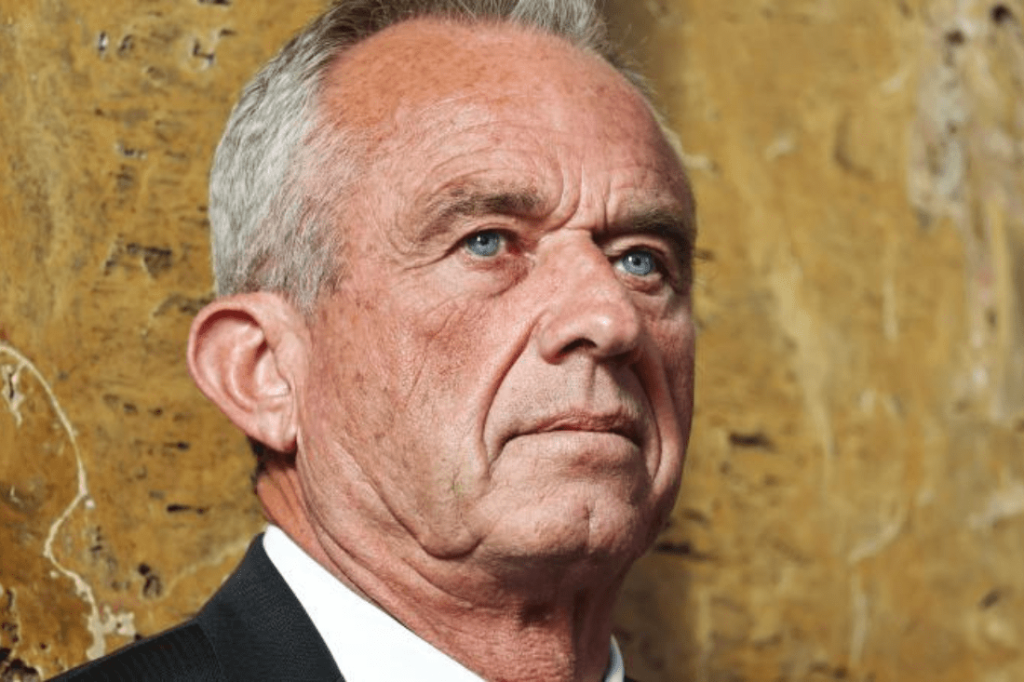
Articles / Coronavirus / Government / Politics & Policy / White House Trump strikes skeptical tone on his own Covid vaccine record, policies For years, Trump has been at odds with his base, who largely opposed the widespread use and coercion associated with the COVID-19 vaccine. Now, he’s reevaluating his past policies and statements. By: President Donald Trump on Monday shot holes in the COVID-19 vaccine accomplishments of his first term, posting on Truth Social that, “They [Pfizer] show me GREAT numbers and results, but they don’t seem to be showing them to many others. I want them to show them NOW, to CDC and the public, and clear up this MESS, one way or the other!!! I hope OPERATION WARP SPEED was as “BRILLIANT” as many say it was. If not, we all want to know about it.” Trump’s support of his own vaccine Trump has been reticent to show any dissatisfaction with Operation Warp Speed, which was announced in 2020 and produced the COVID-19 vaccine in short-order at the onset of the pandemic in 2021, and for the last half-decade, has declined to refer to the public-private partnership as anything other than a success. He frequently highlighted the unprecedented speed of development, which produced the vaccine in under nine months as opposed to the typical five to ten years. Trump also repeated claims of the effectiveness of the vaccines and the program’s role in allegedly saving millions of lives. He credited the program’s success to his administration’s funding (over $18 billion, including $10 billion redirected from hospital funds), deregulation, and partnerships with private companies like Pfizer and Moderna. As recently as August 28 in his cabinet meeting at the White House, Trump touted the vaccine, citing it as a “medical miracle” that saved millions of lives. “Operation Warp Speed people say is one of the greatest achievements ever in politics or in the military … Everybody, including Putin, said that ‘Operation Warp Speed, what you did with that, nobody could believe it.’ We did a great job.” Not very cult-like, Trump’s base disagrees While his detractors criticize his base for being in lock-step with the president on all issues, even going as far as calling them a “MAGA Cult,” even his most ardent supporters have abandoned the notion that the vaccines were “safe and effective.” Trump’s fidelity to the positive vaccine messaging has been at odds not only with his base, but also with many of his own health officials, notably his Health and Human Services director, Robert F. Kennedy Jr., highlighting a rift within the administration, with most of Trump’s base siding with Kennedy. Kennedy, who has been skeptical of many modern vaccines and their outcomes, has been equally critical of the COVID-19 vaccines, which utilized mRNA technology. Earlier in August, Kennedy announced that his department is canceling 22 mRNA vaccine development contracts, totaling roughly $500 million. “After reviewing the science, and consulting top experts at [National Institutes of Health] and [Food and Drug Administration], HHS has determined that mRNA technology poses more risks than benefits for these respiratory viruses,” RFK said in a video posted to X. In November 2020, Pfizer released a statement sharing the results of its COVID-19 vaccine trials, stating that its vaccine was “95% effective against COVID-19 beginning 28 days after the first dose.” Fresh questions on “safe and effective” A Canadian watchdog group, the National Citizens Inquiry (NCI), published a report concluding that COVID-19 vaccines were “neither safe nor effective,” citing flaws in the authorization mechanism that allowed approvals without standard clinical trial data. The report highlighted concerns about adverse effects and efficacy, alleging that the rushed process compromised public safety. Further, a lawsuit filed by Texas Attorney General Ken Paxton against Pfizer, which is ongoing, alleges that far from the 95% figure, the Pfizer vaccine is less than 1% effective. Trump, who asserts that he’s hearing different data and statistics from the vaccine manufacturers versus what they are telling the public, continued in his Truth Social post, “It is very important that the Drug Companies justify the success of their various Covid Drugs. Many people think they are a miracle that saved Millions of lives. Others disagree!” “With CDC being ripped apart over this question, I want the answer, and I want it NOW. I have been shown information from Pfizer, and others, that is extraordinary, but they never seem to show those results to the public. Why not???” Trump and Kennedy’s unusual partnership While Trump and Kennedy’s views on matters like climate and the environment vary greatly, since Kennedy’s Make America Healthy Again (MAHA) merged with Trump’s Make America Great Again (MAGA) movement, the two have had a surprisingly drama-free relationship. In an interview with Tucker Carlson in June, Kennedy told Carlson, “I had him pegged as a narcissist, but narcissists are incapable of empathy. And he’s one of the most empathetic people that I’ve met.” “He’s immensely curious and inquisitive. And immensely knowledgeable. He’s encyclopedic in certain areas,” he continued. Kennedy’s alignment with Trump came at considerable personal cost to him. Members of the Kennedy family called the former independent presidential candidate’s 2024 endorsement of Trump a “betrayal.” TOP STORIES Trump strikes skeptical tone on his own Covid vaccine record, policies Trump’s executive order to protect the U.S. flag hits at heart of culture Newsom targets Trump as proxy for potential 2028 GOP presidential candidates, nominee Cities across America would benefit from Trump’s D.C.-style takeover Trump to make upgrades to White House, the first of this century LATEST EPISODES IL GOP Leader McCombie blasts Gov. Pritzker for deflecting to Trump while Chicago crime remains out-of-control Biden’s Retaliation Backfires: DOJ settles with FBI whistleblowers—major victory for Empower Oversight ‘SCOTUS didn’t get it right the first time,’ Texas AG Paxton backs Trump on flag burning executive order $7 Million Seized, No Charges Filed: A Shocking Story of One Family’s Fight Against Amazon & abuse by FBI, DOJ Amanda Head breaks down the latest headlines with Just The News reporters, Ben Whedon and Natalia Mittelstadt RELATED ARTICLES Trump strikes skeptical tone on his own Covid vaccine record,

America, Articles, Elections, Government, Politics & Policy, White House

Newsom targets Trump as proxy for potential 2028 GOP presidential candidates, nominee

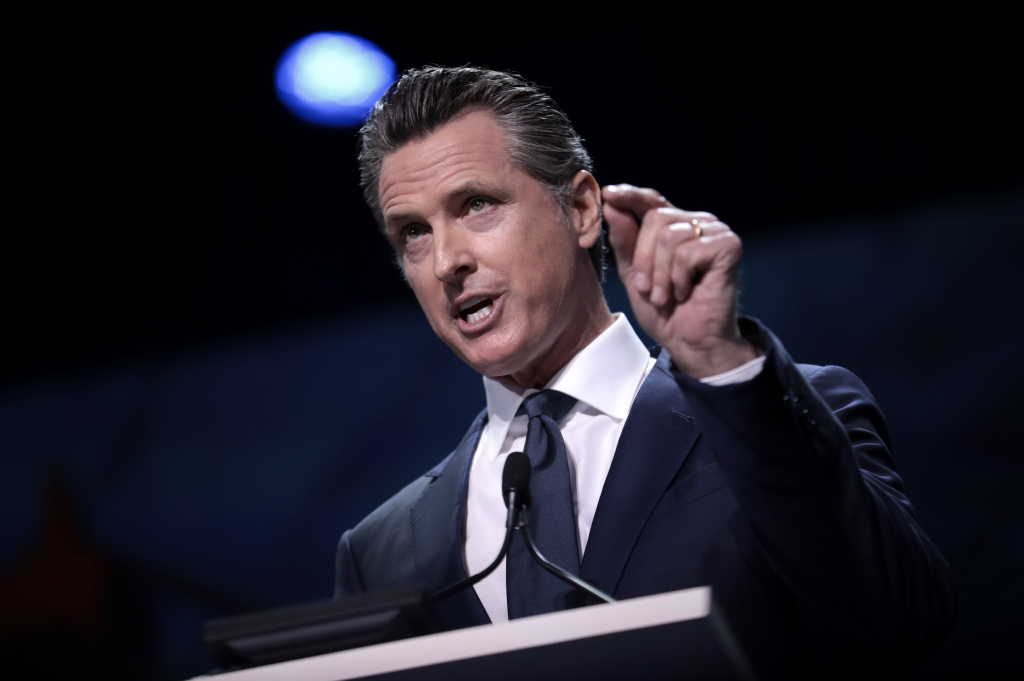
America / Articles / Elections / Government / Politics & Policy / White House Newsom targets Trump as proxy for potential 2028 GOP presidential candidates, nominee Though 2028 won’t be opportunity for Newsom to go head-to-head with Trump, his latest tactic is imitating the president to boost his political capital. By: The next presidential election will not be a match between California Gov. Gavin Newsom and President Donald Trump. But Newsom – considered a top-tier, potential 2028 Democratic presidential candidate – is walking and talking like he’s running and that the GOP nominee will be a Trump acolyte. Among Newsom’s recent and most notable moves appears to be imitating Trump’s signature, all-capitalized social media posts, including two with his infamous signoff: “THANK YOU FOR YOUR ATTENTION TO THIS MATTER!” “DONALD TRUMP, IF YOU DO NOT STAND DOWN, WE WILL BE FORCED TO LEAD AN EFFORT TO REDRAW THE MAPS IN CA TO OFFSET THE RIGGING OF MAPS IN RED STATES. THANK YOU FOR YOUR ATTENTION TO THIS MATTER!,” the governor’s press office posted Aug. 12, ahead of the state’s Democrat-controlled Assembly’s ultimately successful effort Thursday to pass a series of Newsom-backed bills to redraw the state’s congressional maps. The effort was in response to a similar one in the GOP-controlled Texas Assembly, and backed by Trump, to try to pick up more House seats in the 2026 midterm elections. (Newsom later Thursday signed two of the three bills and declared a Nov. 4 special election in which voters will be given the opportunity to grant final approval to the newly drawn maps.) Ahead of Trump’s meeting last week with Russian President Vladimir Putin, Newsom’s office posted: “DONALD IS FINISHED — HE IS NO LONGER “HOT.” FIRST THE HANDS (SO TINY) AND NOW ME — GAVIN C. NEWSOM — HAVE TAKEN AWAY HIS “STEP.” MANY ARE SAYING HE CAN’T EVEN DO THE “BIG STAIRS” ON AIR FORCE ONE ANYMORE — USES THE LITTLE BABY STAIRS NOW. SAD! TOMORROW HE’S GOT HIS “MEETING” WITH PUTIN IN “RUSSIA.” NOBODY CARES. ALL THE TELEVISION CAMERAS ARE ON ME, AMERICA’S FAVORITE GOVERNOR. “EVEN LOW-RATINGS LAURA INGRAM (EDITS THE TAPES!) CAN’T STOP TALKING ABOUT MY BEAUTIFUL MAPS. YOU’RE WELCOME FOR LIBERATION DAY, AMERICA! DONNIE J MISSED “THE DEADLINE” (WHOOPS!) AND NOW I RUN THE SHOW. THANK YOU FOR YOUR ATTENTION TO THIS MATTER! — GCN” GOP strategist Mike Biundo, who served as campaign adviser to Trump and GOP Sens. Rick Santorum, Pennsylvania, and Rand Paul, Kentucky, told Just The News, “Enter failed Governor Gavin Newsome, riding in on his Trump-Derangement-Syndrome horse, with no record to run on and no policy wins to tout. So what does he do to infuse his fledgling, low-energy national foray? He tries to give it a Trump-trolling sugar high. The problem for him is that, like most sugar highs, it won’t last.” In the 24 hours preceding the writing of this article, the Newsom press office directly mentioned and attacked Trump in 12 posts with others indirectly referencing Trump or his policies. Newsom’s strategy appears to be working, according to the latest University of California Irvine-OC Poll. In early June, just 38% of poll respondents approved of the overall job that he was doing as governor. But when voters were asked the same question by the same pollsters, after Newsom’s fight with Trump over the federalization of the National Guard in response to protests in Los Angeles, his approval rose to 56%. And in a poll conducted by Politico and The Citrin Center public opinion firm and released Wednesday, Newsom was the top presidential choice of 25% of California’s Democratic voters for the 2028 Democratic primary. The poll also showed that among state Democrats, Newsom is leading all prospective candidates, including Kamala Harris, the 2024 Democratic nominee, who garnered 19% of their support. On the inaugural episode of his new podcast, on March 6, Newsom broke from progressives by speaking out against allowing males to compete in female sports. He made the declaration to conservative activist Charlie Kirk, telling him, “I think it’s an issue of fairness. I completely agree with you on that. It is an issue of fairness – it’s deeply unfair.” Newsom has also flip-flopped on other issues, like the use of the term “Latinx,” California’s high-speed rail, state oil production, bail reform, and the current hot topic, redistricting. Biundo also said: “The Democratic Party as a whole is desperately searching for an identity. The American people only need to compare President Trump’s record with Newsom’s in California to see that he is a non-starter. As a Republican Operative, I hope the Democrats nominate Newsom. I am in the mood for another landslide from whatever candidate we put up as the GOP nominee.” TOP STORIES Trump’s executive order to protect the U.S. flag hits at heart of culture Newsom targets Trump as proxy for potential 2028 GOP presidential candidates, nominee Cities across America would benefit from Trump’s D.C.-style takeover Trump to make upgrades to White House, the first of this century Trump 2.0 White House hones messaging to challenge false stories, engage pop culture LATEST EPISODES Biden’s Retaliation Backfires: DOJ settles with FBI whistleblowers—major victory for Empower Oversight ‘SCOTUS didn’t get it right the first time,’ Texas AG Paxton backs Trump on flag burning executive order $7 Million Seized, No Charges Filed: A Shocking Story of One Family’s Fight Against Amazon & abuse by FBI, DOJ Amanda Head breaks down the latest headlines with Just The News reporters, Ben Whedon and Natalia Mittelstadt Rep. Grothman: ‘Watergate was nothing compared to Hillary Clinton’s lies to manipulate 2016 election’ RELATED ARTICLES Trump’s executive order to protect the U.S. flag hits at heart of culture Newsom targets Trump as proxy for potential 2028 GOP presidential candidates, nominee Cities across America would benefit from Trump’s D.C.-style takeover Trump to make upgrades to White House, the first of this century Trump 2.0 White House hones messaging to challenge false stories, engage pop culture Critical Condition: America faces a supply chain crisis for basic drugs, and Trump wants to fix it Trump GDP, tariffs and inflation data

Articles, Education, Politics & Policy

Biden’s unconstitutional free ride for student loan borrowers ends August 1

Articles / Education / Politics & Policy Biden’s unconstitutional free ride for student loan borrowers ends August 1 Teaching students fiscal responsibility: The new guardrails rein in Biden-era student loan cancellation, reduces federal spending on loan forgiveness, and imposes stricter borrowing and repayment structures. By: In an announcement video posted to X, Department of Education Secretary Linda McMahon announced that beginning August 1, the Department of Education will resume charging interest on student loans under the Saving on a Valuable Education (SAVE) Plan enacted under former President Joe Biden. That plan was ruled an unconstitutional overreach of power by the United States Supreme Court in June 2023. The Biden administration introduced the SAVE Plan in the summer of 2023 and billed it as an affordable repayment program, but it was legally challenged and is now defunct. Critics argued in editorials that it was “straight up buying votes” and a blatant attempt to buy votes for the Democratic Party. This change marks a broader overhaul of the federal student loan system under President Trump’s administration, which will phase out the SAVE Plan and other income-driven repayment plans that claimed to eliminate or lower payments for borrowers, but in practice handed the bill to American taxpayers. The Trump administration’s view on the issue is that loan cancellations are “vile” and are not a viable option as it merely shifts debts from one party to another, specifically not allowing American taxpayers to take on debts that are not their own. Admin presents online array of options In the announcement, McMahon encouraged borrowers to go to a link, StudentAid.gov, to learn about what they are characterizing as affordable, legal repayment options, as the Department of Education will provide assistance in identifying new plans. The debate over whether student loans should be forgiven is steeped in the issue of what is objectively considered fair. Many, especially Republican legislators, question why student loans should be forgiven when hundreds of thousands of young Americans enlist in the military to pay for their education with their service. They also ask why mostly liberal arts majors were favored in the now-moribund plan over young Americans who skip a four-year degree and opt instead for vocational or trade school. What changes are coming? The One Big Beautiful Bill Act, which Trump signed on July 4, overhauls the federal student loan system, impacting nearly 43 million borrowers with stricter borrowing limits and reduced repayment options. The SAVE plan will be fully phased out by July 1, 2028, and interest accrual will resume on August 1, 2025. New borrowing limits which will go into effect in July of 2026, cap graduate student loans at $20,500 annually and $100,000 lifetime, while professional degrees will be limited to $50,000 annually and $200,000 lifetime. Parent PLUS loans are capped at $20,000 per year and $65,000 per child. Also, there will now be a combined loan limit for undergraduate and graduate loans of $257,500. Repayment options are to be streamlined into two plans: a standard plan with 10- to 25-year terms based on debt size, and the Repayment Assistance Plan (RAP), which ties payments to income. The former starts at $10 monthly for those earning $10,000 or less, up to 10% of adjusted gross income for higher earners. The RAP waives unpaid interest and provides up to $50 monthly principal reduction for lower-income borrowers, but requires a $10 minimum monthly payment. Loan forgiveness under RAP extends to 30 years, compared to 20 or 25 years in prior plans, making it less likely for typical borrowers to qualify. Current borrowers can access the older Income-Based Repayment (IBR) plan for loans made before July 1, 2026, offering forgiveness after 20 or 25 years. The legal issues surrounding SAVE have created administrative complications, thus IBR forgiveness processing is paused, with refunds promised for any overpayments. TOP STORIES Biden’s unconstitutional free ride for student loan borrowers ends August 1 Hoaxes about ICE ‘disappearing’ illegals are widespread, as disinformation seeps into the news US Olympic Committee bends to Trump, bars trans athletes from women’s competition Trump signals he may designate organizers, financial backers of violent ICE protests as terrorists Trump embraces special prosecutor for weaponization probe and Epstein, vows new declassifications LATEST EPISODES Intel Cover-Up & Corruption: Two Insiders Tell All From Years of Obama-Era Coup Attempts & Epstein Scandal FBI Secrets, Federal Assets & the 1995 Oklahoma City Bombing: The Truth About John Doe No. 2 Mike Davis: ‘Go forward with indictments,’ all Dems part of Russia Hoax should ‘lawyer up, justice is coming’ The Conservative Crackdown: Republicans Confront Lawlessness, Antisemitism & Deep State Bias Exclusive with President Trump: Jeffrey Epstein, Hillary Clinton, Jerome Powell, FBI, no topic off limits RELATED ARTICLES Biden’s unconstitutional free ride for student loan borrowers ends August 1 Hoaxes about ICE ‘disappearing’ illegals are widespread, as disinformation seeps into the news US Olympic Committee bends to Trump, bars trans athletes from women’s competition Trump signals he may designate organizers, financial backers of violent ICE protests as terrorists Trump embraces special prosecutor for weaponization probe and Epstein, vows new declassifications Growing tariff revenues, court rulings raise hopes Trump could put U.S. on path to balanced budget Texas firefighters on Austin fire chief: ‘dereliction of duty’ cost lives Texas Land Commissioner says the camps did everything they could to avoid the flood’s tragic rage Food manufacturers rush to remove certain food dyes to comply with new FDA guidance Trump’s fight to keep non-citizens off voter rolls reignites in second term

America, Articles, Extremism, Local, Politics & Policy

Texas firefighters on Austin fire chief: ‘dereliction of duty’ cost lives

America / Articles / Extremism / Local / Politics & Policy Texas firefighters on Austin fire chief: ‘dereliction of duty’ cost lives As the death toll from the central Texas floods surpasses 120 with 170 still missing, Austin’s fire chief is in the crosshairs of firefighters who claim his refusal to respond and assist in the rescue effort cost lives. By: The fire chief in Austin, Texas, a city known as a liberal hipster hub in a deep red state, is under sharp scrutiny for refusing to provide assistance in the days preceding the catastrophic and deadly central Texas floods last weekend. Austin Fire Department chief Joel Baker was the subject of scorn by his own firefighters’ union, the Austin Firefighters Association, which posted scathing remarks on social media about Baker during and in the aftermath of the floods that thus far have taken 121 lives, many of them children, with at least 170 people still missing. “It brings the Austin Firefighters no pleasure to report to the community that the Austin Fire Chief DENIED the deployment of Austin firefighters to Kerrville until very late into the event (so today!), with the exception of only 3 AFD rescue swimmers who helped staff helo teams (which still were NOT deployed until the afternoon of the 4th),” the post stated. “Helo teams” is jargon for specialized helicopter rescue units, specializing in emergency response capabilities for water-related emergencies. All about money allegedly owed to the city? The post goes on to explain that Austin’s Firefighter Special Operations teams are trained for specific challenges, just like the Hill Country floods where swift water rescue is required. The union’s post goes on to place blame squarely on Baker’s shoulders: “It is absolutely outrageous that the Austin Fire Chief, Joel G. Baker, would not allow highly trained firefighters from Austin to respond to Kerrville. Because of this egregious dereliction of duty, LIVES WERE VERY LIKELY LOST BECAUSE OF CHIEF BAKER’S DECISION!” According to the Facebook post, requests for assistance came from the state of Texas on July 2, two days prior to the floods, and another request on July 3, both of which were denied by Baker. “It is unforgivable that a fire chief would NOT allow his firefighters to answer the call to save lives,” the post continued. The firefighters also asked rhetorically: “Why would Fire Chief Joel G. Baker do this, you may ask? It was a misguided attempt to save money. I say “misguided” because the fire department is fully reimbursed by the state to deploy. I explained the reimbursement process to Chief Baker last week, and he failed to understand this very simple concept.” The criticism came after the Austin Fire Department announced it would not deploy personnel outside of Austin because of a budget shortfall, including “something like $800,000 in outstanding reimbursements owed to AFD by the State of Texas,” according to local station KXAN-TV. The TV station also reported that Baker said he issued the pause on deployments due to “internal issues” over the state’s ability to reimburse the department, insisting that budget constraints had “nothing” to do with his decision-making. Other cities answered the call CBS News reported that fire and rescue departments from North Texas heeded the call to assist: Fort Worth Fire Department sent two teams and Dallas Fire-Rescue deployed a water squad of six people. Other departments in the surrounding area also sent support: Mountain Home Fire Department, Ingram Volunteer Fire Department, Denton Fire Department, Houston Fire Department, and Galveston Fire Department were actively involved. Texas A&M Forest Service deployed Texas Intrastate Fire Mutual Aid System strike teams to assist local fire departments, indicating a broader network of fire service involvement. Surrounding states also sent support: Shreveport, Louisiana, and Memphis, Tennessee deployed teams to contribute to the efforts. Additionally, international teams also came to aid in the search and rescue efforts: a team of 13 firefighters from Ciudad Acuña, Mexico, through Fundación 911, assisted in Kerr County. The city comes to Baker’s defense The Austin Fire Department responded to the allegations by telling the local Fox television affiliate that “The decision about how to allocate resources to help our fellow Texans is not a simple one. It requires communication from public safety partners on the ground to ensure we are providing resources and personnel when, where and how they are most needed.” “The Austin Fire Department must also prioritize having sufficient resources in our own community given the unpredictability of this weekend’s storms and the risk for catastrophic flooding in our immediate area,” the department said. Austin City Manager T.C. Broadnax issued a statement addressing the accusations, saying “It is disappointing that the Firefighters Association would make these allegations and consider such a vote, especially while these communities continue to grieve and recover.” “It’s even more disheartening how quickly the Association’s claims spread, because so many people are ready to place blame. The City of Austin, and the Austin Fire Department in particular, have a very long track record of supporting and sending aid to neighboring communities in need,” he continued. “No confidence” vote “To be clear, I continue to have confidence in Chief Baker and remain committed to listening and working with both the Chief and the Fire Association to ensure that the Austin Fire Department is able to continue supporting our neighbors while protecting our local community,” the City Manager added. The union held an “emergency” meeting Tuesday, voting unanimously to hold a vote of no confidence in Baker, The New York Post reported.  “We could’ve made a difference, and we were forced to stand down and lives were lost,” the union said. Donations supporting relief and rebuilding efforts after the flood are being collected, and the local Fox affiliate has created a web page in conjunction with The Community Foundation, a 501(c)(3) public charity serving the Texas Hill Country. TOP STORIES Growing tariff revenues, court rulings raise hopes Trump could put U.S. on path to balanced budget Texas firefighters on Austin fire chief: ‘dereliction of duty’ cost lives Texas Land

Articles, Federal Agencies, Government, Health, Politics & Policy

Food manufacturers rush to remove certain food dyes to comply with new FDA guidance

Articles / Federal Agencies / Government / Health / Politics & Policy Food manufacturers rush to remove certain food dyes to comply with new FDA guidance Americans are increasingly demanding that chemicals and toxic food dyes be removed from items they consume, clean with, wear, apply to their skin and use in their homes. By: In compliance with directives from the United States Department of Health and Human Services (HHS) and the Food and Drug Administration (FDA), many of the nation’s largest food conglomerates have announced preemptive efforts to remove artificial food dyes from their products. Thus far, Kraft Heinz, General Mills, Tyson Foods, Nestlé, Conagra Brands, Walmart and Sam’s Club, and PepsiCo have announced discontinuation or an intent to discontinue use of the food dyes prior to the advised deadline. The announcements come after the FDA and HHS urged a phase-out of petroleum-based synthetic food dyes from the U.S. food supply. On April 22, HHS Secretary Robert F. Kennedy Jr. and FDA commissioner Marty Makary announced measures to eliminate these dyes by the end of 2026, primarily through voluntary industry compliance rather than a formal mandate. Kennedy: “Real, measurable dangers” The FDA is also revoking approval for the use of specific dyes, such as Citrus Red No. 2 and Orange B, and encouraging faster removal of FD&C Green No. 3, Red No. 40, Yellow No. 5 and No. 6, Blue No.1 and No.2, with a prior deadline set for January 2027. In a statement accompanying the new guidelines, Kennedy said, “For too long, some food producers have been feeding Americans petroleum-based chemicals without their knowledge or consent. These poisonous compounds offer no nutritional benefit and pose real, measurable dangers to our children’s health and development.” “That era is coming to an end. We’re restoring gold-standard science, applying common sense, and beginning to earn back the public’s trust. And we’re doing it by working with industry to get these toxic, dies out of the foods our families eat every day.” The FDA is simultaneously fast-tracking the review of natural alternatives to synthetic food dyes such as calcium phosphate, Galdieria extract blue, gardenia blue, and butterfly pea flower extract. According to recent CivicScience data, 79% of U.S. adults at least “somewhat” support the FDA’s plan to phase out certain artificial food dyes, significantly outnumbering the 21% who are at least “somewhat” opposed. Parents of children over 12 show stronger support for the phase-out than those with younger children, despite younger kids potentially being more vulnerable to the health impacts of these dyes. Not the expected “health food” demographic Support is highest among Republicans, the demographic most closely aligned with Kenney’s Make America Healthy Again (MAHA) movement. Additionally, high-income individuals (earning $100,000+ annually), adults 65+, men, and those with graduate or professional degrees are more supportive of the dye removals than their counterparts. The transition to natural food dyes could prove to be bumpy with a lot of trial-and-error. Winner of the cooking competition TV show “Master Chef,” Whitney Miller, who founded Whitney’s Cookies in Franklin, Tennessee, experienced similar struggles when she decided to make all of her products with natural ingredients. “I did have to research and try to find the best ones, because there really wasn’t a lot of options out there. I think now, hopefully, as people are talking about it more, and we’re pushing everyone to change over, there will be more options. But it is a little bit of a research struggle,” she told Just The News. Miller said it can also depend on what color a manufacturer is seeking. She said it’s a little bit easier with certain dyes like pink or red, in which case “there are strawberries that are freeze-dried, that you can pulverize and make a natural color.” However, other colors are trickier, like blue. Blueberries produce a purple color, not blue, so Miller ultimately formulated her own blue dye. According to Miller, the medium matters as well. “You have to test in the market when you’re putting them [dyes] in, whether it be ice cream or whether it be a baked good. Baking is a science, cooking is a science. And when you’re getting into these natural dyes, it’s going to perform differently in a baked item than it is in an ice cream or a drink.” Supply of natural colors a challenge For large companies like General Mills and PepsiCo, Miller said, “that’s where these different companies are going to have to do a lot of testing and figure out what can work best for them.” When asked about the suppliers of the natural food dyes, Miller said, “I’ve only seen one, one supplier. So that’s gonna be tough.” Volume will also be a complicating factor for large manufacturers who will require large amounts of the dyes. Miller said she has often had to seek out natural dye suppliers in Canada, which could further complicate the supply chain depending on what transpires with President Donald Trump’s trade talks with Canadian Prime Minister Mark Carney. TOP STORIES Food manufacturers rush to remove certain food dyes to comply with new FDA guidance Trump’s fight to keep non-citizens off voter rolls reignites in second term Hegseth announces new intel on US bombing Iran, criticizes media for pushing preliminary report Trump’s next battlefields: a NATO-snubbing Spain and a conflicted U.S. intel community Trump bombed Iran into a ceasefire and sent a loud message to China and Russia LATEST EPISODES Surf’s Up, WOKE’s Down: Comedian Jonathan Wayne Freeman shreds cancel culture & the censorship kooks Trump’s ‘One Big, Beautiful Bill’ exposed GOP divide & fuels Musk’s threat to form a new political party Trump’s Chief Economic Policy Advisor defends the One Big Beautiful Bill Act, Rep. Biggs also weighed in Supreme Court strikes back, Jesse Binnall says anti-Trump, rogue judges just got checked Trump’s strategic strike on Iran crippled their nuclear ambitions, sparking a new path for regime change RELATED ARTICLES Food manufacturers rush to remove certain food dyes to comply with new FDA guidance Trump’s fight to keep non-citizens off voter rolls reignites

All Things Trump, Articles, Elections, Politics & Policy

Trump’s fight to keep non-citizens off voter rolls reignites in second term

All Things Trump / Articles / Elections / Politics & Policy Trump’s fight to keep non-citizens off voter rolls reignites in second term Part one of President Donald Trump’s battle to keep illegal aliens off voter rolls began near the end of his first term and will likely come hurtling back in the near future. By: The Supreme Court has never made a determination on the legal merits of the argument that noncitizens should not be counted in the United States census, but may soon be forced to do so. The fight to clarify the census and subsequently adjust congressional seats, Electoral College votes and federal funding, is coming down the pike, according to White House deputy chief of staff, Stephen Miller. Miller indicated last month that he’s eager to dive straight in and that Commerce Secretary Howard Lutnick will help lead the effort. Trump has at his disposal a number of avenues to accomplish his goal, one of which includes Lutnick’s agency. Utilizing this route, the Commerce Department could propose adding a census question to distinguish citizens, legal permanent residents, and unauthorized immigrants, as suggested by a lawsuit filed by Republican-led states and the Department of Commerce in January 2025. The data could then be used to exclude noncitizens from apportionment, though not necessarily from the overall count. Republican support for this approach is growing, with bills introduced by Rep. Chuck Edwards, R-N.C., and Sen. Bill Hagerty, R-Tenn., to mandate a citizenship question and thus exclude noncitizens from apportionment. A GOP-controlled Congress could facilitate approval of such questions, due by 2028. The Supreme Court’s 2019 ruling rejected the citizenship question due to procedural issues, and demanded a stronger justification for having the case reviewed by the Supreme Court before going to the Court of Appeals for the Second Circuit. Amending the Census Act is an option Furthermore, Trump could work with Congress to pass legislation amending the Census Act to exclude noncitizens from apportionment counts or mandate a citizenship question. Bills like those proposed by Edwards and Hagerty aim to achieve this, but such legislation would need to redefine “persons” in the 14th Amendment’s apportionment clause to exclude noncitizens, a significant departure from historical practice. It could also direct the Census Bureau to use citizen-only data for apportionment. With a Republican-controlled Congress, the winds are now more favorable. Passage is significantly more likely than in 2020, when a similar House bill passed on a party-line vote (206-202) but stalled in the Democratic-controlled Senate. President Donald Trump, on his first day in office, rescinded a Biden-era executive order on January 20, 2025, which had reaffirmed counting all residents regardless of immigration status, signaling intent to revisit this policy. With a GOP-controlled Congress, there may be less political resistance to try again. Additionally, preparations for the 2030 census will begin during Trump’s second term, and federal law requires proposed census questions to be submitted to Congress two years prior, which gives a window to influence the process. Estimates of illegal alien populations vary due to inconsistent methods and tracking, but based on the most reliable and recent data from multiple sources including the Department of Homeland Security, the state with the highest number of illegal aliens is California, with 2.6 million. Texas took the number two spot with 2.06 million, and Florida comes in at third with 560,000. New York (with 540,000)  and New Jersey (with 440,000) rounds off the top five. Despite the influx of illegal aliens to California, it lost a congressional seat due to the number of residents fleeing the state. The Orange County Register reported that California lost 817,669 residents in 2023 for a net outmigration of 341,866 citizens. If that trend continues, according to Thad Kousser, who is an expert in California and national politics and a professor of political science at UC San Diego, California will lose another four seats by 2030, even without census criteria changing. Texas would hypothetically gain three seats and Florida would gain three. Whether noncitizens count for census matters that affect representation In 2020, the Trump administration sought to exclude noncitizens from the U.S. Census count which is used to apportion congressional seats and Electoral College votes, a move that sparked significant controversy. In July of that year, President Donald Trump issued a memorandum directing the Census Bureau to use administrative records to identify and exclude undocumented immigrants from the apportionment count, arguing that including them dilutes the political power of citizens and constitutes voter suppression. The administration argued that the Constitution’s mandate to count “persons” did not explicitly require counting noncitizens for apportionment. This effort faced immediate legal challenges from blue states and cities, many of which were sanctuary jurisdictions, and immigrant advocacy groups, who argued the policy violated the Constitution and would discourage immigrant participation in the census, potentially undercounting communities with large noncitizen populations. The Supreme Court ultimately blocked the Trump administration’s plan in December 2020, ruling that the memorandum was premature and lacked sufficient justification, though it did not address the merits of the Administrations’ argument. Critics, including the American Civil Liberties Union, hailed the decision as a victory for fair representation, while supporters of the policy, including then-Commerce Secretary Wilbur Ross, argued it was necessary to ensure electoral fairness. Without time for the issue to play out further, the Census Bureau claimed it was constrained by time and logistical challenges, and ultimately included all residents in the 2020 count. TOP STORIES Trump’s fight to keep non-citizens off voter rolls reignites in second term Hegseth announces new intel on US bombing Iran, criticizes media for pushing preliminary report Trump’s next battlefields: a NATO-snubbing Spain and a conflicted U.S. intel community Trump bombed Iran into a ceasefire and sent a loud message to China and Russia Ten years after Trump’s golden escalator announcement, Republicans campaign on transformed agenda LATEST EPISODES Supreme Court strikes back, Jesse Binnall says anti-Trump, rogue judges just got checked Trump’s strategic strike on Iran crippled their nuclear ambitions, sparking a new path for regime change Trump’s precision strike on Iran sent a global message, Victoria Coates talks on restoring American deterrence Iranian threats,

All Things Trump, Articles, Elections, Politics & Policy

Ten years after Trump’s golden escalator announcement, Republicans campaign on transformed agenda

All Things Trump / Articles / Elections / Politics & Policy Ten years after Trump’s golden escalator announcement, Republicans campaign on transformed agenda Trump’s Republican Party looks wildly different from ten years ago, and Republicans must codify and expand his populist ideas if they want to hold the majority in next year’s midterm election. By: As congressional representatives head home to campaign in their districts this week, the party priorities look very different from those of 2015. Ten years ago, when then-candidate Donald Trump descended the golden escalator at his midtown Manhattan Trump Towers property, it produced a spark that spread American populism fire throughout the Republican Party, a party which at the time was mired by warmongering, false promises of fiscal responsibility and acquiescing to leftist accusations and policy. The official party platform in 2015 remained the party agenda from the previous general election in 2012. The priorities enumerated weren’t that far off from what was listed in the 2024 party platform. But, even four months into his second term, President Donald Trump clearly took his promises seriously and is working to enact what voters sent him to Washington to do. In 2012, the Republican Platform titled “We Believe In America” was 62 pages and was adopted at the Tampa, Florida Republican National Convention. It reflected the personality and politics of then-candidate Mitt Romney. In 2024, the Republican Platform, titled “Make America Great Again,” clocked in at 16 pages, consisting of 20 clear and concise agenda items. Among those items: to seal the border and stop the migrant invasion, to carry out historic deportation operations, to make America affordable again, to make Trump’s tax cuts from 2018 permanent, to strengthen and modernize the military, to keep men out of women’s sports and to keep the US dollar as the world’s reserve currency. Economy The 2012 platform, in many more words, emphasized reducing the federal deficit through spending cuts and supported a balanced budget amendment with a cap on federal spending. It also advocated for a simpler, flatter tax code with lower rates for individuals and businesses to stimulate economic growth. The official party platform expressed opposition to new taxes and aimed to make the bush tax cuts from 2001 and 2003 permanent. Unsurprisingly, it promoted free market policies and reducing government interference to encourage economic growth and entrepreneurship, particularly supporting small businesses. Trump’s economic ideas similarly reflect those from the 2012 platform, with demonstrably more muscle and enactment. The Trump Tax Cuts and Jobs Act (TCJA) lowered income tax rates across most brackets, with the top rate dropping from 39.6% to 37%. The standard deduction nearly doubled (e.g., $12,000 to $24,000 for married couples), benefiting about 70% of taxpayers who take it over itemizing. The Tax Policy Center estimated 65% of households saw tax cuts in 2018, averaging $1,600, though benefits skewed toward higher earners. Government reform Similar to the party platform from 2024, the 2012 platform called for rolling back excessive regulations, particularly those from the Obama administration and appointing judges who adhere to constitutional originals. It called for reducing the size and scope of the federal government, returning power to states and individuals. It advocated for eliminating wasteful programs and reforming. Sound familiar? If so, that’s because many Americans voted on this very issue in support of what is now the Department of Government Efficiency instituted under Trump. National defense and foreign policy The 2012 platform, similar to Trump’s agenda, called for maintaining a robust national defense, modernizing the military, and ensuring adequate funding. It opposed budget cuts and advocated for American exceptionalism, supporting allies like Israel and confronting adversaries like Iran. It also promoted democracy abroad, which is a departure from Trump’s platform which advocated for “no new wars” and a strong opposition to the nation-building ways of the Republicans of 2012. Social issues While many Republicans take issue with the novel “big tent” personality of the party present day, it’s undeniable that on one particular traditional issue, abortion, Trump has done more to protect the sanctity of life that any other president. The 2012 platform supported a constitutional amendment to protect unborn life and opposed  funding for abortion through organizations like. The 2012 platform also sought a constitutional amendment to define marriage  between one man and one woman. Education In 2012, the party platform, promoted parental choice and education, including charter schools, vouchers, and homeschooling. It opposed federal overreach in education. It also called for reducing federal involvement in student loans and encouraging private sector alternatives and trade schools. One of the 20 policy points in the 2014 MAGA agenda was to, “cut federal funding for any school pushing critical race theory, radical gender ideology, and other inappropriate racial, sexual, or political content on our children.” On March 20, 2025, Trump issued an executive order directing Education Secretary Linda McMahon to take all legally permissible steps to facilitate the closure of the Department of Education and transfer its authority to states and local communities. TOP STORIES Ten years after Trump’s golden escalator announcement, Republicans campaign on transformed agenda ‘Rubber stamp’ vaccine advisory board fired by RFK Jr. for conflicts of interest has revealing past Weekend of LA riots shows media hasn’t learned anything from America’s election of Trump Second Lady Vance launches reading initiative to combat abysmal literacy rates Weaponized sugar pill? Homeland ends controversial and costly Quiet Skies domestic spying program LATEST EPISODES Fleitz: Biden’s weak Iran policy made regime $100B wealthier, funded Hamas Oct. 7 slaughter of Israelis ‘One electromagnetic pulse attack & we’re set back to 1871, Iran is plotting it now,’ warns top expert Army soldier branded ‘white supremacist,’ ousted from service for photo of Trump sparking Congressional defense California In Crisis: Gov. Newsom, Mayor Bass blasted over illegal immigration & public safety failures Mom-Turned-Activist takes on California’s vaccine laws in explosive court battle RELATED ARTICLES Ten years after Trump’s golden escalator announcement, Republicans campaign on transformed agenda ‘Rubber stamp’ vaccine advisory board fired by RFK Jr. for conflicts of interest has revealing past Weekend of

Articles, Education, Politics & Policy

Second Lady Vance launches reading initiative to combat abysmal literacy rates

Education / Politics & Policy Second Lady Vance launches reading initiative to combat abysmal literacy rates Literacy rates have plummeted over the last half-century, with 34% of U.S. fourth-grade students below basic reading levels in 2022. 31% were below what’s considered “proficient.” By: On June 1, Second Lady Usha Vance launched her literacy initiative called the Summer Reading Challenge, which seeks to improve childhood literacy among students in kindergarten through 8th grade, the ages which are the most vital to literacy education and improvement. The National Assessment of Educational Progress (NAEP) reported a decline in reading proficiency, with 2023 scores for 13-year-olds dropping 4 points compared to 2020, and 9-year-olds scoring 5 points lower than in 2020. Only 43% of U.S. fourth graders scored at or above proficient in reading, with stark disparities by race: 17% of Black students and 21% of Latino students reached proficiency compared to higher rates for White and Asian students. The new program challenges children to read 12 books of their choice between June 1 and September 5, 2025. They are instructed to track their progress using a reading log provided by the White House and participants must list book titles, authors, completion dates, and provide a brief reflection or drawing about their favorite book. Upon completion, children will receive a personalized certificate and a small prize, and are then entered into a drawing for a chaperoned trip to Washington, D.C. The literacy legacy Numerous literacy-related programs have been instituted by the White House throughout the nation’s history. Former First Lady Abigail Fillmore, First Lady of the United States from 1850 to 1853, did not establish a formal “literacy program” in the modern sense, but her most significant contribution to literacy was the creation of the first White House Library. A teacher since age 16, her initiative reflected her lifelong passion for education and reading, stemming from her belief in equal access to education for women. Former First Lady Eleanor Roosevelt championed literacy through New Deal initiatives like the Works Progress Administration (WPA) library programs and bookmobiles, providing access to books for underserved communities, particularly during the Great Depression. As an avid reader and writer, Roosevelt used her “My Day” column and White House literary and poetry events to promote intellectual engagement and the value of reading. Her efforts, though not a single formal program, advanced literacy as a tool for empowerment, especially for poor, rural communities, and groups like African Americans and women. Perhaps the most famous FLOTUS literacy initiative was former First Lady Barbara Bush’s Foundation for Family Literacy, which to date has provided more than $110 million to create or expand family literacy programs throughout the country. Furthering the Bush family’s legacy, former First Lady Laura Bush initiated the National Book Festival in 2001, which still attracts more than 120,000 attendees each year. While not associated with the White House, Pizza Hut’s “BOOK IT!” program was created in 1984 by Arthur Gunther, then-president of Pizza Hut, in response to President Ronald Reagan’s call for businesses to support education. Inspired by his son Michael’s struggles with reading due to eye problems, Gunther collaborated with educators in Wichita, Kansas, to develop the program, which rewarded children with free Personal Pan Pizzas for meeting reading goals. Vance’s program also aims to promote mental health benefits like stress reduction through reading, as supported by Baylor College of Medicine research. The challenge is designed to be accessible nationwide, with schools and libraries expected to support its rollout. TOP STORIES Second Lady Vance launches reading initiative to combat abysmal literacy rates Weaponized sugar pill? Homeland ends controversial and costly Quiet Skies domestic spying program Trump moves on from Musk rift, touts agenda victories Culture, sports and business worlds all dialing back support of ‘Pride Month’ Amanda Head presses White House on antisemitic terrorism, vaccine religious exemptions in ‘new media’ seat LATEST EPISODES Mom-Turned-Activist takes on California’s vaccine laws in explosive court battle Tariffs, Treachery & the CCP: Rep. Moore puts his foot down to loosen China’s strategic grip on America Phil Kerpen on the clash up on Capitol Hill: Will Trump’s ‘One Big, Beautiful Bill’ survive the Senate? Fight Club-Secret Service Edition: What went down at Obama’s home? Susan Crabtree’s reporting tells all Ghost-Signed Green Agenda? Watchdog Exec says Biden may not have authorized key executive orders RELATED ARTICLES Weaponized sugar pill? Homeland ends controversial and costly Quiet Skies domestic spying program Trump moves on from Musk rift, touts agenda victories Culture, sports and business worlds all dialing back support of ‘Pride Month’ Amanda Head presses White House on antisemitic terrorism, vaccine religious exemptions in ‘new media’ seat White House to Jewish Americans: ‘This president has your back’ Energy group says Biden had no knowledge of climate change EOs, doubt validity of autopen use Trump accuses China of violating ‘fast’ trade deal he made to save country’s economy White House to send DOGE rescissions package to Capitol Hill: Report Trump’s ‘Big, Beautiful Bill’ major step in dismantling the regulatory state with REINS Act Despite decades of Democrat health initiatives, Americans are sicker than ever

Articles, Government, Politics & Policy, White House

White House to send DOGE rescissions package to Capitol Hill: Report

Articles / Government / Politics & Policy / White House White House to send DOGE rescissions package to Capitol Hill: Report As Americans watch the DOGE ticker move, showing how much money its cuts could potentially save taxpayers, Congress must codify as much as it can through legislation. By: The White House plans to send a package of domestic spending cuts, based on recommendations from the Department of Government Efficiency (DOGE), to Capitol Hill this week, according to Republican officials who spoke to several House GOP members on Wednesday. The proposed cuts aim to eliminate expenditures referred by DOGE for the chopping block, amounting to nearly $9 billion in previously approved spending reductions, targeting agencies like USAID and public broadcasting entities, such as NPR and PBS. DOGE, led by Elon Musk, has already implemented significant cost-saving measures without Congress, but Republican senators have expressed skepticism about formalizing these cuts into law. The spending cut recommendations will undoubtedly face challenges as Congress focuses on a broader tax and spending bill, with GOP leaders warning of limited legislative bandwidth before the next shutdown deadline of September 30, 2025. A potential legal challenge to the Impoundment Control Act could emerge if Congress resists, as the Trump administration considers unilateral action to enforce the cuts. TOP STORIES White House to send DOGE rescissions package to Capitol Hill: Report Trump accuses China of violating ‘fast’ trade deal he made to save country’s economy Trump’s ‘Big, Beautiful Bill’ major step in dismantling the regulatory state with REINS Act Despite decades of Democrat health initiatives, Americans are sicker than ever Trump‘s ‘big, beautiful bill’ delivers decades-long conservative wish list, if it outlasts bickering LATEST EPISODES Ghost-Signed Green Agenda? Watchdog Exec says Biden may not have authorized key executive orders The Price of Freedom: Honoring Heroes & Defending America with Jimmy Graham on Memorial Day Rep. Grothman voted for Trump’s ‘One Big Beautiful Bill,’ blasted Biden’s open border failures & welfare bloat Border Czar Tom Homan touts Trump’s ‘One, Big, Beautiful Bill’ as necessary solution to enhance border security Biden could’ve been quietly treating prostate cancer with ADT treatment for months, even during presidency RELATED ARTICLES White House to send DOGE rescissions package to Capitol Hill: Report Trump accuses China of violating ‘fast’ trade deal he made to save country’s economy Trump’s ‘Big, Beautiful Bill’ major step in dismantling the regulatory state with REINS Act Despite decades of Democrat health initiatives, Americans are sicker than ever Trump‘s ‘big, beautiful bill’ delivers decades-long conservative wish list, if it outlasts bickering Trump: Putin call went ‘very well’, negotiations to start ‘immediately’ Trump to lift Syria sanctions, give country a ‘chance at peace’ Trump signs historic agreements with Saudi Prince Trump’s voyage to Gulf States to strengthen U.S. economic, diplomatic ties Trump signals no slowdown on 100th day, lays out ambitious agenda for trade, tax cuts and Mars

Articles, Politics & Policy, Polling

Trump’s ‘Big, Beautiful Bill’ major step in dismantling the regulatory state with REINS Act

Articles / Politics & Policy / Polling Trump’s ‘Big, Beautiful Bill’ major step in dismantling the regulatory state with REINS Act The regulatory state hamstrings everything from cosmetology to bridge placement. Reeling it in with the REINS Act may unleash billions in prosperity and remove the regulatory yokes from American manufacturers, business owners and consumers. By: When the House of Representatives last week passed Trump’s “Big, Beautiful Bill,” there was a poison pill for the regulatory state buried within: the long-lingering REINS (Regulations from the Executive in Need of Scrutiny) Act that proponents have been trying to send to the Oval Office for signature for 16 years. The implications of such a bureaucratic dressing-down would reverberate throughout all of U.S. industry and consumerism. Environmental Protection Agency Administrator Lee Zeldin told Just The News, No Noise TV show that his hope is that it gets over the finish line and once it does, a cascade of other burden-easing improvements can take place. “As you look forward with the legislative agenda, there will be other opportunities to get permanent reform done, NEPA (National Environmental Policy Act) reform to make it easier to invest in America at less cost, taking less time and having more certainty,” he said. It was originally introduced in 2009 by then-Rep. Geoff Davis, R-Ky., with the goal of increasing congressional oversight of federal agency rule-making. The current version of the bill stipulates that agency rules with an annual economic impact of $100 million or more, significant cost or price increases for consumers or industries, or substantial adverse effects on competition, employment, investment, productivity, innovation, or US competitiveness, would require explicit approval from both the House and Senate via a joint resolution and then be signed by the president before taking effect. Stopping waste before it begins The REINS Act seeks to amend the existing Congressional Review Act (CRA), which currently allows lawmakers to void certain agency regulations after implementation. The REINS Act would reverse that process, requiring preemptive approval by Congress for major rules. If enacted, it would provide Congress with more direct control over major regulations with significant economic impacts by granting legislators the preemptive authority to halt the enactment of certain regulations, rather than relying on resolutions of disapproval after a rule takes effect. A wide range of industries would likely see a tectonic shift, including energy, healthcare, pharmaceuticals, financial services, manufacturing and construction, transportation, agriculture and food safety. Phil Kerpen, who serves as president of American Commitment, referred to it as “unfinished business from the Tea Party era” and told Just The News that this could be the most significant aspect of the bill because it “would be a massive, positive change, and stop this pendulum from swinging wildly back and forth with the party in the White House. We’d have a lot more policy stability.” In addition to concrete steps towards regulatory overhaul and passing Trump’s “Big, Beautiful Bill,” if Republicans remain committed to the issues upon which they were elected, they could quite possibly remain in the majority, thus granting Trump two more years to govern without obstructionist Democratic Party constraints. What matters to voters: more than money After Trump’s second victorious presidential campaign, almost all the “How Trump Won” post-mortems reckoned that economic affairs were at the top of the list for most voters. Even before the general election, policy analysts pointed to the economy as a leading indicator of what was driving American voters’ preferences. The Pew Research Center noted that after their polling, “eight-in-ten registered voters (81%) say the economy will be very important to their vote in the 2024 presidential election.” Pew’s research also found that “Voters have more confidence in Trump than Harris on economic, immigration and foreign policies. Half or more voters say they are at least somewhat confident in Trump to make good decisions in these areas, while smaller shares (45% each) say this about Harris.” In CBS’ review, the network acknowledged that “One of the most important factors in [this year’s] election is the economy, specifically inflation” and cited one of their own analysts saying that throughout the pre-election polling, voters marked it as the top issue, and that Trump had always had an advantage with people who said the economy was their top concern. Polling? It depends on who you ask Legacy news outlets would have Americans believe that Trump’s platform, especially on issues like mass deportations, is wildly unpopular. The Nation played along with that narrative, blaring an April 29 headline that read “Trump’s Poll Numbers Have Collapsed.” The admittedly anti-Trump outlet began with a salvo of invective, calling him “a historically unpopular president” and described his less-than-six-month-old tenure a “combination of scorching ineptitude and creeping authoritarianism.” However, voter sentiment from a wider scope of polling — perhaps with a less pre-determined story to tell — reflects quite the contrary. A recent Cygnal poll found that despite Trump’s first 100 days in office receiving 92% negative press coverage, 63.5% support deporting illegals from the country. Only 30.8% oppose and another 5.8 percent remain unsure. That poll queried 1,500 voters and has a margin of error of +/- 2.5%. In direct contravention to the left’s “doom and gloom” reading of the tea leaves, a new Rasmussen Reports survey released Tuesday reports that, for the first time in the poll’s nearly two-decade history that a majority of the country says the country is on the right track. Far from the “historically unpopular” image The Nation and others are trying to conjure as reality, the Rasmussen survey shows that nearly half of likely U.S. voters believe the country is heading in the right direction. The national telephone and online poll, conducted for the week ending May 22, 2025, found that 48% of likely voters think the nation is on the right path, while 41% still believe it is on the wrong track, Rasmussen Reports concluded. With a margin of error of +/-3%, even if the error favors the “wrong track” view, that still puts the country in a position where Republicans, with majorities in both Houses, and President Donald Trump in the White House, can

Articles, Health, Politics & Policy

Despite decades of Democrat health initiatives, Americans are sicker than ever

Articles / Health / Politics & Policy Despite decades of Democrat health initiatives, Americans are sicker than ever Over the last 15 years, Democrats have reared multiple failed health initiatives that could be reversed or altered under the Trump administration’s health leadership, leading to better overall health and a reduction in chronic diseases. By: Health and Human Services (HHS) Secretary Robert F. Kennedy Jr. had a viral and heated exchange with Senator Patty Murphy, D-Wash., during a Senate Appropriations hearing last week that was supposed to focus on budget priorities for his department. The exchange between the two went off the rails when Murray accused Kennedy of “sprinting down the road to illegally impounding billions in funding through intentional action and incompetence.” She highlighted a number of programs which fall under his purview that Kennedy has considered altering or omitting. Kennedy’s came back with a mic-drop response that tied decades of growing health problems in America to the policies of Murray’s party. “Senator, you’ve presided here, I think for 32 years. You have presided over the destruction of the health of the American people. Our people are now the sickest people in the world, because you have not done your job,” Kennedy fired back. Data and history back up his argument. Most recently, the COVID-19 pandemic destroyed public trust in health authorities and agencies. In April 2020, trust sat at a reasonable 71.5%. Four years later in April 2024 it plummeted to 40.1%, according to a 50-state survey of U.S. adults led by Northeastern University’s distinguished professor of political science and computer sciences. Apart from that devastating effect, the response to the pandemic has been roundly criticized. What should have been a health initiative for the non-vulnerable to get outside for natural vitamin D absorption, encouraging exercise, healthier diets and healthy hygiene behaviors like handwashing, turned into a nation locked down, isolated and sick. A blend of federal and state efforts—lockdowns, mask mandates, testing, and vaccine rollouts—were utilized to control the pandemic. But it was Republican-led states like Georgia, Texas and Florida, who bucked the lockdowns and fully reopened. Democrat-led states like California, Oregon, New York and Hawaii remained locked down with mandates in place until spring 2022. The U.S. endured one of the highest per-capita death rates among wealthy nations (over 1 million deaths by 2022, 3,493 per million people). Inconsistent messaging, delayed testing (only 1 million tests/day by late 2020 vs. needed 5 million), and politicized mandates eroded trust. Underfunded public health infrastructure — CDC’s budget barely grew in real terms from 2014–2023— left agencies scrambling. Another failed Democrat health program: former President Barack Obama’s Affordable Care Act or Obamacare. It aimed to expand healthcare access, reduce costs, and improve care quality through insurance mandates, exchanges, and Medicaid expansion. The truth and the outcome are vastly different than its intended purpose. While it insured 20 million more people, premiums and deductibles soared. The average family premium exploded 61% from 2010 to 2020, and as a result, bureaucracy ballooned. Rural hospital closures spiked (138 since 2010), and some argue it entrenched a profit-driven system rather than addressing root inefficiencies. As premium prices rose, coverage quality declined. In February 2010, former First Lady Michelle Obama launched “Let’s Move,” a public health initiative aimed at reducing childhood obesity and promoting healthy lifestyles among children in the United States. In the midst of a growing obesity pandemic, it sought to encourage healthier eating habits through school lunch programs, increase physical activity and provide better access for nutritious foods. The reality is that obesity rates haven’t demonstrably changed: 42% of U.S. adults were obese in 2020, up from 30% in 2000. The “Let’s Move” program often focused and implemented change in individual behavior while ignoring structural issues like food desserts, subsidy-driven cheap junk food, and sedentary environments. The Healthy Lunchbox Campaign in California backfired when free lunch bags were found to contain lead, exposing kids to health risks. And once again, it’s Republican-led states leading the charge to remove unhealthy sodas and energy drinks from food stamps and SNAP programs. Nebraska just became the first state to receive a federal waiver to ban the purchase of soda and energy drinks under the SNAP program. In a news conference last month, Nebraska’s Republican Gov. Jim Pillen said: “There’s absolutely zero reason for taxpayers to be subsidizing purchases of soda and energy drinks. Snap is about helping families in need get healthy food into their diet, but there’s nothing nutritious about the junk we’re removing with today’s waiver.” Arkansas, West Virginia, Iowa, Kansas, Indiana, and Colorado have also submitted requests for waivers banning certain unhealthy foods and drinks. TOP STORIES Despite decades of Democrat health initiatives, Americans are sicker than ever Trump‘s ‘big, beautiful bill’ delivers decades-long conservative wish list, if it outlasts bickering Trump: Putin call went ‘very well’, negotiations to start ‘immediately’ Trump to lift Syria sanctions, give country a ‘chance at peace’ Trump signs historic agreements with Saudi Prince LATEST EPISODES Rep. Grothman voted for Trump’s ‘One Big Beautiful Bill,’ blasted Biden’s open border failures & welfare bloat Border Czar Tom Homan touts Trump’s ‘One, Big, Beautiful Bill’ as necessary solution to enhance border security Biden could’ve been quietly treating prostate cancer with ADT treatment for months, even during presidency Retired Secret Service Agent & FBI Exec. on Comey’s ‘8647’ post: “highly irresponsible, what was he thinking?” Trump redraws Middle East map securing economic deals & creating peace, successfully isolating Iran RELATED ARTICLES Despite decades of Democrat health initiatives, Americans are sicker than ever Trump‘s ‘big, beautiful bill’ delivers decades-long conservative wish list, if it outlasts bickering Trump: Putin call went ‘very well’, negotiations to start ‘immediately’ Trump to lift Syria sanctions, give country a ‘chance at peace’ Trump signs historic agreements with Saudi Prince Trump’s voyage to Gulf States to strengthen U.S. economic, diplomatic ties Trump signals no slowdown on 100th day, lays out ambitious agenda for trade, tax cuts and Mars Federal workers are waging a resistance against Trump agenda. It’s captured in videos and polling

Articles, Congress, Government, Politics & Policy, White House

Trump‘s ‘big, beautiful bill’ delivers decades-long conservative wish list, if it outlasts bickering

Articles / Congress / Government / Politics & Policy / White House Trump‘s ‘big, beautiful bill’ delivers decades-long conservative wish list, if it outlasts bickering The bill funds and codifies many of President’s priorities and could help GOP approval on Capitol Hill at a time when many voters aren’t pleased by lack of progress. By: The “One Big Beautiful Bill” that President Donald Trump personally lobbied Congress to pass Tuesday delivers on decades of conservative wishes, but first it must survive bickering over two very different issues: deductions for high-tax state voters and the size of spending cuts in an era of record debt. Speaker Mike Johnson was working feverishly Tuesday night to eliminate one of the roadblocks — demands to increase the State and Local Taxes (SALT) Deduction cap — while fiscal hawks were being pressed to trust that Trump and his DOGE-infused, regulation-busting team can deliver more than the $1.6 trillion in spending cuts the current legislation enacts over the next decade. A final push will require some conservatives to make a leap of faith, like Rep. August Pfluger, R-Texas, the chairman of the House Republican Study Committee, is taking. “Look as a conservative, I want to save as much money as I can, and we have pushed for that in the Republican Study Committee,” Pfluger told Just the News on Tuesday. “But the President was pretty clear that we’ve worked five or six months straight on this, and it is time to get it done. “That doesn’t mean that a guy like me doesn’t want more. Yes, of course I do. But I also want to govern, which means you don’t get 100% of everything you want every single time. You have to come back and do it again, and we will,” he said during an interview on the John Solomon Reports podcast. There were signs of progress Tuesday night as blue-state Republicans who want more than the legislation’s tripling of the SALT deduction (from its current $10,000 cap to $30,000) were negotiating with Johnson toward a deal. A tentative agreement was reportedly reached late Tuesday. Meanwhile, Rep. Gabe Evans, R-Col., told the Just The News, No Noise TV show, that conservative hawks were already making deeper cuts through the traditional appropriations process outside the “One Big, Beautiful Bill” and succeeding in lowering spending from the targets set for some programs in a budget blueprint passed just weeks ago. “I think we’ve already seen some of that happen already. In the reconciliation process, you actually have to pass the bill twice. The first time you pass the bill, you’re setting those top line numbers for how much either cuts or spending is going to occur under those committees of jurisdiction,” Evans explained. “But then when you come through and you actually build the policies to meet those top line numbers, there’s no mandate that you actually have to spend all of the money that you’re allocated.” Therefore, if this administration and Congress start treating congressional appropriations as ceilings, not floors, that will allow Trump to spend less when the job is done efficiently and for less money. Rep. Rudy Yakym, R-Ind., told Just The News that spending will likely be reduced again this summer and fall after the reconciliation bill passes in the form of clawbacks of prior approved spending. “He [Trump] can do that through rescission packages, which we would expect that he’ll be sending us some rescissions here sometime later on this year,” Yakym explained. Meanwhile, high-profile conservatives like House Judiciary Committee Chairman Jim Jordan were imploring colleagues to appreciate and message to voters just how many conservative agenda items are stacked in the bill already, many which have been on wish lists for years or decades. “What I think we really need to be doing as Republicans, is talking about how good this bill is,” Jordan said on the Just the News, No Noise TV show Monday. “I mean, there’s a reason Democrats hate it. Democrats hate it because it’s all about Republican principles. “We’re the party that says cut taxes. We’re the party that says secure the border. We’re the party that says we should require work for able-bodied adults who are getting taxpayer money. This bill does all three of those,” he added. The White House sent out an email from the Office of Communications outlining specific reasons it feels Republicans in Congress must unite behind the funding package. At the top of the list of 20 reasons why sits Trump’s tax cuts, which would be the largest in history and an extra $5,000 on average for Americans through a double-digit decrease to their tax bill. It also includes Trump’s “No Tax On Tips” and “No Tax On Overtime” and “No Tax on Social Security” provisions. The list also prioritizes “Big, Beautiful Deportations,” permanently securing borders by making the largest border security investment in history. Much of that investment will be allocated to funding at least one million annual deportations of illegal immigrants. The immigration allocation also includes funding to finish Trump’s border wall, which began construction during Trump’s first term. It also empowers immigration authorities to carry out their duties with an additional workforce of about 10,000 new ICE personnel, 5,000 new customs officers, and 3,000 new Border Patrol agents. For border workers on the front lines, they’ll receive $10,000 bonuses. Trump has also been adamant that this bill, with his backing, will protect Medicaid by removing at least 1.4 million illegal migrants off the rolls, saving taxpayers’ money. Additionally, it requires able-bodied Americans to work if they receive benefits starting in January 2029. The bill, according to the White House, also “reverses the spending curse plaguing Washington, D.C.” and delivers the largest deficit reduction in nearly 30 years, amounting to $1.6 trillion in mandatory spending. This bill also reportedly puts an end to taxpayer-funded sex changes for minors. Under the Biden administration, Medicaid covered so-called “gender transition” procedures for minors. The provision in this bill reverses that. The legislation also allows for historic modernization and a complete overhaul to

All Things Trump, Articles, Government, Politics & Policy, Syria, White House, World

Trump to lift Syria sanctions, give country a ‘chance at peace’

All Things Trump / Articles / Government / Politics & Policy / Syria / White House / World Trump to lift Syria sanctions, give country a ‘chance at peace’ Normalizing relations with the troubled nation could mean further and broader peace in the region. By: Speaking before a crowd of investors, political figures, and business leaders in Riyadh on Tuesday, Trump followed through on previous hints that he would lift sanctions on Syria, adding that they served an important function at the time but that Syria should be given a “chance at peace.” “I will be ordering the cessation of sanctions against Syria in order to give them a chance at greatness,” Trump told an investment summit in Riyadh on Tuesday. TOP STORIES Trump to lift Syria sanctions, give country a ‘chance at peace’ Trump signs historic agreements with Saudi Prince Trump’s voyage to Gulf States to strengthen U.S. economic, diplomatic ties Trump signals no slowdown on 100th day, lays out ambitious agenda for trade, tax cuts and Mars Federal workers are waging a resistance against Trump agenda. It’s captured in videos and polling LATEST EPISODES Flashback to 2020: Trump puts American patients first, signs executive order slashing drug prices Pope Leo XIV: The American Revolution that just hit the Vatican Emmy Award-winning Actress accuses FBI of framing her husband in botched China case, calls for Trump pardon NIH closes labs accused of killing thousands of dogs, White Coat Waste Project takes well-deserved victory lap U.S.-India on brink of an historic trade pact that could redefine global commerce, Arun Agarwal discusses RELATED ARTICLES Trump to lift Syria sanctions, give country a ‘chance at peace’ Trump signs historic agreements with Saudi Prince Trump’s voyage to Gulf States to strengthen U.S. economic, diplomatic ties Trump signals no slowdown on 100th day, lays out ambitious agenda for trade, tax cuts and Mars Federal workers are waging a resistance against Trump agenda. It’s captured in videos and polling Halfway down in unrelated story, NYT admits Russia collusion was bogus Trump physical results released, he ‘remains in excellent health,’ doctor says White House projects confidence in tariff plan, points to ‘very good’ progress White House replaces historic ‘Jackson Magnolia’ with descendant sapling Trump imposes historic 10% tariffs against most nations, vows to ‘supercharge’ economy

All Things Trump, Articles, Government, Politics & Policy, Saudi Arabia, White House, World

Trump signs historic agreements with Saudi Prince

All Things Trump / Articles / Government / Politics & Policy / Saudi Arabia / White House / World Trump signs historic agreements with Saudi Prince The agreements will increase coordination across business, military, government and culture. By: During his trip to Riyadh on Tuesday, President Donald Trump and Saudi Arabia’s de facto ruler, Crown Prince Mohammed bin Salman, signed more than a dozen agreements addressing each nation’s armed forces, justice departments, and cultural institutions. Tuesday’s U.S.-Saudi agreements mark a win for 45th president, who has set a goal of reaching $1 trillion in U.S. investment by the Gulf nation. Since taking office, Trump has already secured $600 billion from the Crown Prince over the next four years. The investments span technology, defense, energy and other sectors including purchase commitments by the Saudis for American goods. Trump will also travel to Qatar and the United Arab Emirates before returning to Washington on Saturday. TOP STORIES Trump signs historic agreements with Saudi Prince Trump’s voyage to Gulf States to strengthen U.S. economic, diplomatic ties Trump signals no slowdown on 100th day, lays out ambitious agenda for trade, tax cuts and Mars Federal workers are waging a resistance against Trump agenda. It’s captured in videos and polling In sudden shift, Democrats take lead in generic election ballot as voters fret about finances LATEST EPISODES Flashback to 2020: Trump puts American patients first, signs executive order slashing drug prices Pope Leo XIV: The American Revolution that just hit the Vatican Emmy Award-winning Actress accuses FBI of framing her husband in botched China case, calls for Trump pardon NIH closes labs accused of killing thousands of dogs, White Coat Waste Project takes well-deserved victory lap U.S.-India on brink of an historic trade pact that could redefine global commerce, Arun Agarwal discusses RELATED ARTICLES Trump signs historic agreements with Saudi Prince Trump’s voyage to Gulf States to strengthen U.S. economic, diplomatic ties Trump signals no slowdown on 100th day, lays out ambitious agenda for trade, tax cuts and Mars Federal workers are waging a resistance against Trump agenda. It’s captured in videos and polling Halfway down in unrelated story, NYT admits Russia collusion was bogus Trump physical results released, he ‘remains in excellent health,’ doctor says White House projects confidence in tariff plan, points to ‘very good’ progress White House replaces historic ‘Jackson Magnolia’ with descendant sapling Trump imposes historic 10% tariffs against most nations, vows to ‘supercharge’ economy Did NPR, PBS write their own obituaries before Congress? Some lawmakers think yes

All Things Trump, Articles, Government, Politics & Policy, White House, World

Trump’s voyage to Gulf States to strengthen U.S. economic, diplomatic ties

All Things Trump / Articles / Government / Politics & Policy / White House / World Trump’s voyage to Gulf States to strengthen U.S. economic, diplomatic ties Trump’s Gulf States diplomatic travel may have far-reaching and enduring mutual economic benefits between the region and the U.S., and maybe even some semblance of peace. By: This week, President Donald Trump will visit Qatar, Saudi Arabia, and the United Arab Emirates in a trip aimed at fortifying ties and broadening economic cooperation and investments in the region. Building on relationships forged during his first term through the historic Abraham Accords, the trip will focus mostly on economic deals between the U.S. and its Middle East partners, with diplomatic relations as a secondary goal. Billed by regional news publications as “high stakes,” the Gulf States summit will begin on May 13 in Riyadh, followed by meetings in Doha with the Emir of Qatar, Sheikh Tamim al-Thani. On May 15, Trump will travel to Abu Dhabi and meet the UAE’s President Mohammed Bin Zayed (MBZ). Possible gift of a new Air Force One to the United States Prior to the trip on Friday, press secretary Karoline Leavitt was asked if this trip could lead to Trump personally profiting from business deals made on the trip. “I think it’s frankly ridiculous that anyone in this room would even suggest that President Trump is doing anything for his own benefit. He left a life of luxury and a life of running a very successful real estate empire for public service, not just once but twice,” she responded. Referencing repeatedly substantiated reporting that former President Joe Biden and his family monetized the Biden family name, she told the reporter, “I don’t remember these types of questions being asked of my predecessor about a career politician who was clearly profiting off of this office. That is not what President Trump does, and this White House holds ourselves to the highest of ethical standards.” Nonetheless, the Associated Press and ABC News published stories on Sunday that called into question the propriety — or legality — of a planned gift from the ruling family of Qatar, specifically, a luxury-configured Boeing 747-8 jumbo jet.  The plane would be transferred to the United States Air Force — not to Trump — and the USAF would modify the 13-year-old aircraft to meet the required specifications for presidential aircraft. ABC cited unnamed sources saying that a government legal analysis concluded that it is legal for the Department of Defense to accept the aircraft as a gift and later turn it over to the Trump library, and The New York Times noted that the two current Air Force Ones are more than 30 years old and need frequent servicing, sometimes taking months. Calling the gift-giving entirely into question, Ali Al-Ansari, a spokesman for the Qatari government, said that reports of the plane being offered “during the upcoming visit of President Trump are inaccurate.” Saudi policies a high hurdle to jump The talks with Saudi leaders will cross delicate terrain as Crown Prince Mohammed bin Salman, the country’s de facto leader, has stated his nation won’t normalize relations with Israel until Palestinian statehood has been established and a cessation of the war in Gaza is achieved. Those two requirements are not likely to occur anytime soon. According to The Times of Israel, several Arab newspapers reported that Palestinian Authority President Mahmoud Abbas, Syrian President Ahmad al-Sharaa, and Lebanese President Joseph Aoun will attend Trump’s meeting with bin Salman this Tuesday. The outlet also said that, according to a UK-based Arabic newspaper, the initiative came from the Saudi crown prince and was accepted by the President. Bin Salman was widely accused of ordering the 2018 murder of Jamal Khashoggi, a Saudi dissident and Washington Post journalist. The Biden administration determined in 2022 that bin Salman should be granted immunity in a case brought against him by Khashoggi’s wife, and the case was dismissed that year. Trump will be joined by a large delegation to provide support during the pivotal talks, including Secretary of State Marco Rubio, Defense Secretary Pete Hegseth and Treasury Secretary Scott Bessent, who will reportedly fly to the region separately from Trump, to participate in meetings. Commerce Secretary Howard Lutnick is also expected to join the delegation. A large portion of senior staff at the White House, including Trump’s Chief of Staff Susie Wiles and a slate of deputy chiefs, will also be accompanying the president to the Middle East. Destination: Deal-making Business deals involving industries such as oil, plastics, and organic chemicals will be the centerpiece of the trip. Deputy White House Press Secretary Kush Desai told the Just The News, No Noise television show, “I think presidents go over to visit our key allies in the Middle East, and expanding economic ties is definitely a very big part of that. Saudi Arabia, the UAE, Qatar, these are some of our major economic and political allies in the region.” Highlighting progress that could be made on previous developments, Desaid said, “I think we’ll see an expansion of investments. The Saudis have already committed to investing hundreds of billions of dollars under this President. I think the Emirates have as well. So I think we’re going to see a deepening of ties, not just in the economic sense, but also in the political and foreign policy sense, as we try to bring back the historic peace that the Middle East saw under President Trump’s first term.” Trump is not planning to visit Israel on this trip. If you want to read more of the latest by Amanda Head or the team of world class journalists at Just The News, feel free to read more by visiting JustTheNews.com today. TOP STORIES Trump’s voyage to Gulf States to strengthen U.S. economic, diplomatic ties Trump signals no slowdown on 100th day, lays out ambitious agenda for trade, tax cuts and Mars Federal workers are waging a resistance against Trump agenda. It’s captured in videos and polling In sudden shift, Democrats take lead in generic election ballot as voters fret about finances Halfway down

All Things Trump, America, Articles, Government, Politics & Policy, White House

Trump signals no slowdown on 100th day, lays out ambitious agenda for trade, tax cuts and Mars

All Things Trump / America / Articles / Government / Politics & Policy / White House Trump signals no slowdown on 100th day, lays out ambitious agenda for trade, tax cuts and Mars Trump used the first rally of his second presidency to promise battleground state voters in Michigan a brighter future: “You haven’t even seen anything yet!” By: President Donald Trump used the first rally of his second term to assure voters in battleground Michigan the dizzying pace of his first 100 days in office will persist in the next phase of his presidency as he presses to get Americans on Mars, cut taxes and spending in Washington and turn tariffs into trade deals lucrative for everyday workers. “We’ve just gotten started. You haven’t even seen anything yet. It’s all just kicking off,” Trump told an adoring, packed crowd at Macomb Community College in Warren, Mich., nearly six months after sweeping Michigan and the other battleground states en route to winning the 2024 election. “Instead of putting China first, I’m putting Michigan first, and I’m putting America first,” he added. “We’ve just gotten started. You haven’t even seen anything yet. It’s all just kicking off,” Trump told an adoring, packed crowd at Macomb Community College in Warren, Mich., nearly six months after sweeping Michigan and the other battleground states en route to winning the 2024 election. “Instead of putting China first, I’m putting Michigan first, and I’m putting America first,” he added. The 47th president used the speech commemorating his 100th day in office to catalog all the promises he accomplished during that period on inflation to the border and to set the stage for a more ambitious agenda in the weeks and months ahead. adipiscing elit. Ut elit tellus, luctus nec ullamcorper mattis, pulvinar dapibus leo. On one of the most pressing issues in middle America, Trump said he was confident his new tariffs would yield major trade deals with nations from India to Israel now negotiating with his White House. Those deals, he said, will create prosperity, a manufacturing renaissance and better-paying jobs. “They are coming from all over the world. They are coming up, and they are opening plants, and they are talking to us all day and all night. They want to come here,” he said of foreign companies, which have already announced trillions in new investments since Trump won in November. Trump also leaned into cultural issues, reminding the crowd he had just announced that the federal Columbus Day holiday will no longer be celebrated as anything else, like Indigenous Peoples Day. “You Italians are going to love me because just yesterday I brought back Columbus Day in America, especially for Italian-Americans who were so badly treated by its removal,” he said. Trump returned to an issue he first flashed on the campaign trail in conjunction with Elon Musk’s inventive moxie: space exploration. “One day soon, American astronauts will plant the flag on the planet Mars,” he told the crowd. For such an ambitious priority, it would typically be associated with a longer timeline. However, he assured the crowd that “it’s going to happen very soon.” He also assured the crowd that their Medicare and Social Security benefits would be untouched by his administration. “We will always protect Medicare and Social Security for our great seniors with no cuts, and we will defend Medicaid for those great people that are in need.” With respect to the work DOGE has done to root out waste, fraud and abuse in government, Trump said: “The only thing we’re going to cut is the corruption and the crooks.” During the campaign, Trump repeatedly emphasized the economic crisis many Americans were feeling, at the kitchen table, at the gas pump, buying new homes and cars and other expenditures. As he traversed the nation in the months leading up to the campaign, a number of novel ideas morphed into campaign promises, some of which were commandeered by Kamala Harris, like “no tax on tips.” He promised Tuesday night to deliver on all of those, many when Congress passes a sweeping continuing budget resolution in the next few months. “In the coming weeks and months, we will pass the largest tax cuts in American History—and that will include No Tax on Tips, No Tax on Social Security, and No Tax on Overtime. It’s called the one big beautiful bill,” he said. Michigan, and the town of Warren specifically, like many of the Rust Belt states, felt the effects of former President Joe Biden‘s economy intensely. Sitting less than 20 miles north of Detroit’s city center, Trump told the crowd, “After decades of politicians who destroyed Detroit to build up Beijing, you finally have a champion for workers in the White House and instead of putting China first, I’m putting Michigan first, and I’m putting America first.” At one point during Trump’s speech, the crowd erupted into chants of “Three! Three! Three,” seemingly indicating a desire to see a third term from the 45th and 47th president. If you want to read more of the latest by Amanda Head or the team of world class journalists at Just The News, feel free to read or subscribe by visiting JustTheNews.com today. TOP STORIES Trump signals no slowdown on 100th day, lays out ambitious agenda for trade, tax cuts and Mars Federal workers are waging a resistance against Trump agenda. It’s captured in videos and polling In sudden shift, Democrats take lead in generic election ballot as voters fret about finances Halfway down in unrelated story, NYT admits Russia collusion was bogus Trump physical results released, he ‘remains in excellent health,’ doctor says LATEST EPISODES Steve Hilton vows to save California as governor, plan targets housing crisis, gas prices, fleeing small businesses Rep. Huizenga says Trump’s directness brings ‘clarity’ to diplomacy, teases US Senate run to expand majority Rep. Andy Biggs targets judicial bias & country singer John Rich sounds alarm on child exploitation crisis Sexually explicit books in schools & food dyes are

Articles, Politics & Policy, Second Amendment

Second Amendment leaders press DOGE to stop health agencies’ gun control studies

Articles / Politics & Policy / Second Amendment Second Amendment leaders press DOGE to stop health agencies’ gun control studies Contrary to the original intent of a late-nineties budget rider, health agencies like the CDC have spent the last half a decade funding research supporting gun control efforts on behalf of the Biden administration. By: Elon Musk is used to being vilified by the left, particularly since he was tasked by President Donald Trump to lead the Department of Government Efficiency (DOGE) in trimming the waste, fraud and abuse that has bloated federal government. Now, one section of the citizenry is actually asking him to push harder: Second Amendment advocates are asking him to block taxpayer-funded health agencies from spending millions on gun control research. There has been legislation — called the Dickey Amendment — on the books since 1997 that provides a clear pathway for DOGE to remove tens of millions of dollars spent by agencies like the Centers for Disease Control and Prevention (CDC) on gun control research and grants. That law had been followed until 2018, when Congress “clarified” the rider. Resulting in something closer to rescission than clarification, in 2020, the federal omnibus spending bill presented to President Biden earmarked the first funding for such expenditures since 1996. Dickey Amendment revival stalled Last year, Rep. Marianette Miller-Meeks, R-Iowa, revived efforts to stop such research through an amendment to the appropriations package for the Labor, Human Services, and Education departments. It specifically stipulated that “none of the funds made available by this Act may be used by the Centers for Disease Control and Prevention to conduct or support any firearm injury and mortality prevention research.” Miller-Meeks is a longtime supporter of Second Amendment rights. “As a physician and former Director of Public Health in Iowa, I believe that our leading public health agency should be focusing on researching and preventing communicable diseases, which was what the CDC was originally created to do – not prioritizing gun control,” she posted to ‘X’ ahead of the November 15 vote.  It passed in the House of Representatives 216-211. However, it stalled in the Senate and was never signed into law by then-President Joe Biden. Taking guns from Grandpa Now, Gun Owners of America (GOA) one of the nation’s largest gun rights groups, is pushing for the CDC’s gun research department to get the DOGE treatment. GOA Executive Vice President Erich Pratt spoke to Furthermore with Amanda Head Podcast about the funding, including taxpayer money used to study the effectiveness of gun confiscation of all ages and also researching a sundown age for seniors to relinquish personal firearms. “That right there is tilted towards the left…money to study the benefits of expanded background checks and registration, the best age to set a second amendment retirement age for senior citizens,” he continued. “You know, last I checked, there wasn’t a retirement clause on any of the Bill of Rights. But this is what they want to do. They fund these studies to say, okay, you might retire at age 65 but, at age 71, take guns from grandpa.” Research grants currently active within CDC include $3.6 million for ‘firearm retirement’ for senior citizens, $1.2 million for ‘check-ins’ on ‘guns at home,’ $2.1 million to study ‘firearm possession’ by Asian Americans, $126,000 on ‘Black Americans’ elevated gun violence exposure,’ $490,000 on ‘comparing states gun policies,’ $349,000 on ‘showing if firearm law reduces mortality,’ and $518,000 on ‘firearm storage & confiscation laws.’ Musk and the Second Amendment With a self-deletion date set at the country’s semi sesquicentennial next July, DOGE has roughly 470 days to deliver on its promise to drastically reduced the amount of waste, fraud and abuse in the federal government. The current tally is now at $115 billion, according to the DOGE tracker website. While neither DOGE nor Musk have made  announcements concerning the CDC’s gun-control spending, it’s possible that Second Amendment advocates will find a sympathetic ear at DOGE. The National Rifle Association (NRA), through its house organ “America’s First Freedom” produced a wish list for DOGE that asks them to advise President Trump to sign an executive action stating that the ATF cannot attempt to rewrite gun-control law and to restrict the ATF to “treat the lawfully armed public like the law-abiding citizens they are.” The NRA also said that the Biden administration “blamed gun stores for being responsible for rising crime rates, even though the ATF’s own statistics shows this not to be the case.” Suggesting several cuts in specific, the 5 million member 501(c)4 asks DOGE to disband the White House “Office of Gun Violence Prevention;” dismantle the Department of Justice’s “red-flag” law clearinghouse; end what they call “government funding of bogus gun-control advocacy posing as research;” and they recommend revoking the Biden administration’s export licensing crackdown on American gun companies through the U.S. Commerce Department. Although DOGE has not set its sights on any gun-control related waste or abuse — at least publicly — Musk has not been shy about expressing his support for the right to bear arms. On the 2024 campaign trial on behalf of President Trump, Musk responded to Vice President Kamala Harris’ suggested mandatory gun buyback program by saying “The right to bear arms is there to protect free speech and stop a tyrannical government from taking your rights away! That’s why the first thing that all tyrants do is disarm the people, just like Chavez did when he was first elected. After that, no more real elections in Venezuela.” Even in his support for gun ownership, Musk has proven yet again to be something of a contrarian. In 2022, Musk told CNBC in that “I strongly believe that the right to bear arms is an important safeguard against potential tyranny of government. Historically, maintaining their power over the people is why those in power did not allow public ownership of guns.” In the same interview, Musk also underscored his support for “tight background checks” for all gun sales and limiting sales of assault weapons to people in special circumstances, like gun range owners, or people who live in a “high risk location, like gang warfare. If you want

Articles, Elections, Politics & Policy

Angry democrats gone wild

Articles / Elections / Politics & Policy Angry democrats gone wild With wild scenes from the nation’s students deploying to Spring Break hot spots, Democrats are in tight competition for questionable decisions. By: Since the November election produced no discernible pivot from Democrats, midterm battleground voters show no new love for the party or their message. In a blow to platform architects and champions of progressivism in the Democratic Party, a new Navigator Research poll shows that a majority of those polled, 56%, do not believe Democrats are looking out for working people. Just 39% believe they have the right priorities. One of the researchers who conducted the poll met with House Democrats at their Issues Conference on Wednesday in Leesberg, Virginia to discuss the party’s platform heading into the crucial 2026 midterms. If Democrats are able to flip the House of Representatives, it gives them a small boost in combatting President Donald Trump’s agenda. Without that, they will remain effectively powerless to stop anything out of the executive, with the exception of fighting long court battles to overturn Trump and Republicans’ actions. A deeper dive into the poll reveals how voters feel about work and its value to the Democratic Party. Only 44% reported that they think Democrats respect work. An even smaller margin, 39%, believe Democrats value work. An even harsher blow: 69% of voters said Democrats focus too much on being politically correct. 51% said the identifying term “elitist” fits the party well. According to the same survey, however, Republicans have their own set of issues. 54% of respondents said they view Republicans in Congress unfavorably. Roughly one third said they approve of Republicans’ handling of the economy. Perhaps the harshest blow in the results was the finding that among independents, only 27% believe Democrats are focused on helping them. 55% said Democrats are focused on others. Since the campaign for the 2024 general election, the Democratic Party has experienced a great deal of difficultly fusing the fringes of their party and congealing a winning message. On core issues like the border, economy, law-and-order and social issues like trans rights, Democrats stumbled over their own messaging. Since then, they’ve yet to find even one major issue that aligns with broad sentiment in the country. Tennessee Senator Marsha Blackburn joined the Furthermore with Amanda Head Podcast on Friday and spoke to this very issue: “The American people gave Donald Trump an overwhelming vote to deal with the border, inflation, get our country back to its standing in the world, crime in our communities, the bureaucracy and reduce the federal government, and find a way to get this country back on track. Donald Trump made that promise. That is exactly what he with a Republican House, and Republican Senate is doing so the Democrats again find themselves on the wrong side of the issue, and the American people are looking at them and their antics and saying to them, ‘you are out of touch with where the American people are.’” To Blackburn’s point, many high profile Democrats have been airing their grievances publicly. Democrat senator Elissa Slotkin, D-Mich., appeared on ABC’s The View told their viewers, “I think there’s a feeling in the country, and I often say this, we’re about to turn 250-years-old, right? We’re still pretty young for a country. These are, like, our angry teenage years, right?” Further insulting voters she continued, “we are going through this push and pull where we’re happy, we’re sad, we want this, we want that, and what do you do when you have a teenager who’s threatening themselves and others? You just try to get them through this period alive so that their brain can fully form and you can come back.” Another Democrat with brow-raising comments: that of Vermont Senator Bernie Sanders. Sanders, who was born in 1941 and is of Jewish heritage, lived his early years during the Holocaust and World War II. He also was an adult during Vietnam, the Cuban Missile Crisis, and 9/11. Despite living through those harrowing periods in our nation’s past, he told Jon Lovett on Pod Save America that, “these are the scariest times in my life.” Sanders, who owns three homes, told the podcaster, “it is not just that they want to give tax breaks to billionaires and cut programs for working people. Trump is suing major media outlets and is threatening to investigate PBS and NPR. So it’s not only the power of money, it’s also combined with that the movement toward authoritarianism.” TOP STORIES Angry democrats gone wild Beyond budgeting, Republicans hope to force spending ‘showdown’ with two arcane weapons Philadelphia Eagles to visit the White House to celebrate Super Bowl win After a flurry of activity right out of the gate, Trump takes victory lap in speech to America Republicans float two-part plan to avert government shutdown, White House meeting set Wednesday LATEST EPISODES Mike Benz Unredacted: JFK assassination files show CIA’s deep & everlasting covert infiltration of US government Former Health & Human Services Director & FDA advisor applauds Secretary RFK’s ‘Operation Stork Speed’ 5 yrs later, Dr. Risch details where health officials went wrong & why they couldn’t ’slow the spread’ in 15 days MasterChef Winner Turned Queen of Cookies: Whitney Miller’s Journey in Southern Cooking & Baking White House Q&A with Trump, Sen. Blackburn on Dems’ shutdown threat & Mike Howell exposes Biden’s autopen scandal RELATED ARTICLES Angry democrats gone wild Beyond budgeting, Republicans hope to force spending ‘showdown’ with two arcane weapons After a flurry of activity right out of the gate, Trump takes victory lap in speech to America Republicans float two-part plan to avert government shutdown, White House meeting set Wednesday White House pauses all aid to Ukraine amid rift with Zelensky Taiwanese chipmaker commits another $100 billion investment to U.S. Even before Congress acts, Trump’s border policies already crater illegal immigration by 95% Trump’s art of the deal is now becoming the art of the clawback Velocity of early Trump

Articles, Health, Politics & Policy

Healing America: RFK Jr.’s potential first actions to start rebuilding public health

Articles / Health / Politics & Policy Healing America: RFK Jr.’s potential first actions to start rebuilding public health America’s health has been declining for decades. The road was rocky through confirmation but new Secretary of HHS Robert F. Kennedy Jr. plans changes to reverse the trend. By: Since his confirmation by the United States Senate by a vote of 52 to 45, Robert F. Kennedy Jr. will take over the daunting assignment of overhauling America’s Department of Health and Human Services, setting new guidance for vaccines, health protocols, income security programs, funding and implementing health initiatives and more. In August of 2024, Kennedy announced that he was suspending his campaign and endorsing Donald Trump for president. Among the issues he indicated contributed to his decision were the war in Ukraine, free speech, and “a war on our children.” The latter item proved to resonate strongly with the MAGA faithful as they collectively welcomed Make America Healthy Again (MAHA) initiatives and figures into the support base with fervor. At a Glendale, Arizona rally in August, Kennedy joined Trump on stage, walking out to pyrotechnics, the Foo Fighter’s song, “My Hero,” and roaring applause with chants of “Bobby! Bobby!” from the crowd.  Public now more skeptical With previous differences on issue like abortion and environmental causes, the war on children – his health initiatives to end chronic diseases and remove toxic chemicals from items on America’s store and pharmacy shelves – was a home run with the majority of voters.  Perfectly nestled within the MAGA theme to reduce government, fight bureaucracy and establishment medicine, his website cites a mission to “dismantle the corporate stranglehold on our government agencies that has led to widespread chronic disease, environmental degradation, and rampant public distrust.” Seizing on fresh sentiment that the Covid-19 pandemic was mismanaged and used as a means to overregulate and over-mandate, Trump voters were quickly shifting from accepting guidance on the Covid-19 vaccine to skepticism over that vaccine and others, particularly childhood vaccinations.  There are a number of health items the MAG/HA movement is looking to see dealt with soon. Reduce consumption of processed foods Dozens of studies including one published by the BMJ Group found that “diets rich in ultra-processed foods with increased risks for premature death, cardiovascular disease, mental health disorders, diabetes, obesity, and sleep problems.” Despite the dire warnings, ultra processed foods account for more than half of the caloric intake of American households and has increased at a faster pace than consumption of ultra-processed foods outside the home. This is not only a food industry issue, it’s cultural. Iconic American brands like Mountain Dew, Doritos, Coffee-Mate, Dunkin’ Donuts, Pringles and Lays often buy up the most coveted timeslots during the Super Bowl. Food dyes removed This is an issue that predates both Trump and Kennedy’s tenure. On January 16, 2025, the Food and Drug Administration finally issued a ban on Red Dye No 3, also known as Red 3. It is currently used in nearly 3,000 products in the United States despite its ban in other countries. The European Union banned the substance over three decades ago, as well as the UK, China, Japan, Australia and New Zealand. Food dyes serve no nutritional value. They only serve the aesthetics of a food item like maraschino cherry manufacturers who use it to bring out the bright red hues.  In addition to studies done in the 1990’s linking Red 3 to thyroid cancer in rats, it “disrupts thyroid hormone regulation through several mechanisms. It inhibits the thyroid gland’s ability to absorb iodine, a key component for synthesizing thyroid hormones, and blocks an enzyme essential for converting one thyroid hormone to another, contributing to thyroid dysfunction. Along with other impairments in thyroid hormone function, Red 3 increases the risk of thyroid-related disorders. The ban doesn’t go into effect until January 15, 2027, though Kennedy may work immediately to move up that deadline.  Ban Big Pharma from the airwaves While pharmaceutical advertisements on television have been permitted by the U.S. Food and Drug Administration since the mid-1980s, many Americans have noticed a barrage in recent years. They’re not crazy. The number of TV pharma ads exploded 65% between 2012 and 2016. Why? Drug manufacturers found that if they could pique the interest of consumers and patients at home, they would take that interest to the doctor’s office with them and bring it up with their physician. Coupled with the TV campaign was a concerted push by pharmaceutical representatives who love to bomb doctor’s offices and, et voilá. A customer is made. Reliance on pharmaceuticals Only two countries allow such ads: the United States and New Zealand. Naturally, the advertisements highlight the benefits of the drug for the entire purchased time slot, with a rapid-reader rattling off the warnings at the very end and at a lower volume than the rest of the ad.  In general, public sentiment is shifting away from reliance on pharmaceuticals, even if public health tells a different story. Sixty percent of American adults have at least one chronic condition and 12% have five or more, according to the Centers for Disease Control. Conditions like heart disease, cancer, diabetes and chronic respiratory diseases are the most prevalent. These chronic diseases count for more than $1 trillion in healthcare costs annually in the United States. In fact, according to the study, “about 90% of the annual $4.1 trillion health care expenditure is attributed to managing and treating chronic diseases and mental health conditions.”  Americans are sick. And they are sick of being sick. Founder and CEO of Daily Nouri, a company that focuses on balancing all the systems of the body through probiotic health, said that “the American people are eager for answers. Millions of Americans have been demanding transparency into the alarming decline of human health and the simultaneous growth of food and pharma. Americans have asked for, and will be receptive to, common sense solutions.” Challenge the established narrative “Improving health in America is a complex issue without a one-size-fits-all answer. RFK Jr. seeks to adopt a comprehensive approach that encompasses food-related initiatives, exercise, and supplements, in addition to conventional pharmaceuticals

Articles, Politics & Policy

Democrat Dilemma: DEI-driven party elects two white men with beliefs that clash with middle America

Uncategorized Democrat Dilemma: DEI-driven party elects two white men with beliefs that clash with middle America “I think the Democratic brand is hurting because people feel that you cannot, with conviction and integrity, tell me what you honestly feel about some hard issues,” a Democrat leader laments. By: Democrats who pressed diversity, equity and inclusion (DEI) for years and got roundly rejected at the polls last year chose two new executives to lead their party out of the political desert. But there’s one catch: they are two white men who don’t fit the identity politics of the party’s base and hold widely progressive views that clash with Middle America. The Democratic National Committee’s election this past weekend of Minnesotan Ken Martin to be chairman and anti-gun activist David Hogg have mystified political observers on both sides of the aisle after an election in which voters clearly rejected the far-left drift of the party. “Democrats have once again fallen victim to identity politics, and it’s going to be very hard for Democrats to walk away from identity politics,” Rep. Nick Begich, R-Alaska, who ousted a Democrat incumbent in November, told Just the News. “They’ve essentially evangelized their base to the point where the base has religion around identity and that base is not going to be satisfied unless their leadership continues down that line of thinking,” he added. Many Democrats agree, including Faiz Shakir, former manager of Bernie Sanders 2020 presidential campaign. “I’m frustrated by the way in which we utilize identity to break ourselves apart,” he told the crowd. “Listen, I worked at the ACLU. I’m supportive of diversity, equity and all the rest. But we’re competing over the wrong thing when we should be joining together to fight together.” After the election, Shakir continued to be frustrated that new leadership hadn’t solved a core problem. “I think the Democratic brand is hurting because people feel that you cannot, with conviction and integrity, tell me what you honestly feel about some hard issues,” he told an interviewer. The obsession with far-left values has also led Democrats to explain away their stinging election losses with an excuse most voters don’t share. MSNBC’s Jonathan Capehart asked the eight candidates on stage during the DNC election, “So, I’m going to have a show of hands. How many of you believe that racism and misogyny played a role in Vice President Harris’ defeat?” Every single candidate raised their hand, including Martin and Hogg. Soon after, the DNC voted two white men to be its next leaders, rejecting more diverse candidates that included a black woman, two white women and a Muslim man. For many it was a display of hypocrisy for a party whose DEI mantra demanded racial and gender equity in education, government and business over the past several years. Blowback “You can tell a lot about somebody based not on what they say, but what they do. And the Democrat Party, you know, they have a lot of rhetoric around DEI,” Begich said. Polling shows the Democrat focus on DEI comes with a blowback. A recent Napolitan News survey found that 63% of Americans oppose the government doing business with companies that hold the basic tenet of DEI: that America is fundamentally racist and sexist. “DEI was never popular with the public. It had – and still has – a strong following among progressives,” pollster Scott Rasmussen said. “They pushed it into government and corporate America below the radar. Once it became visible, the backlash was inevitable.” What Americans are most concerned about – and hold great hope Donald Trump will fix – are the issues that most impact their pocketbooks and families. Credit card debt has skyrocketed to an historic $1 trillion collectively by spring 2024. Hardship withdrawals from retirement accounts exploded 30% with the most common reason cited being avoiding evictions or foreclosure and unpaid medical bills. In the months following the end of COVID lockdowns and mandates, the lower income 80% of Americans (outside of the wealthiest 20%) had less cash than before the pandemic. The liberal effort to force transgenderism on students also has boomeranged, with even staunch liberals like Bill Maher rejecting it and wondering why it is only a phenomenon in blue states. “If this spike in trans children is all biological, why is it regional? Either Ohio is shaming them or California is creating them,” he quipped recently. Jump in Trump’s approval rating While Democrats lean into issues that polls show cost them the election, Trump is plowing ahead in reversing the Biden agenda and with majority support. His 53% approval rating is 10 points higher than the beginning of his first term. While entrenched in DEI priorities, this is the first time in 14 years that the DNC will not be run by a female or a person of color. To his credit, Martin claims to understand that those priorities must be in the wake. He told The New York Times that “for the first time in modern history, the majority of Americans believe that the Republican Party best represents the interests of the working class and the poor, and that the Democratic Party represents the interest of the wealthy an the elite.” If that sentiment remains and subsequent efforts to reverse course are successful, Democrats can possibly reverse the dynamic that caused Kamala Harris to lose out to Donald Trump with working class Americans. Common sense policies and reaching working class Americans are how you win elections. TOP STORIES Democrat Dilemma: DEI-driven party elects two white men with beliefs that clash with middle America NC GOP Chairman Says Democratic Voter Registrations Are Plummeting As Party Has ‘Abandoned’ Values Johnson Called Biden To Demand More Security For Trump: GOP Rep. Clyde Lawsuit, Charges Over AI Deepfake Robocalls May Shut Down Various Political Speech Before Election Ben Carson Blasts ‘Woke’ Pastors, Warns Church Has Left People ‘Drifting In The Open Sea’ LATEST EPISODES Fired! Veteran volleyball coach has been let go from SJSU for speaking up to protect women in sports Democrat governors

Articles, Elections 2024, Politics & Policy

NC GOP Chairman Says Democratic Voter Registrations Are Plummeting As Party Has ‘Abandoned’ Values

Articles / Elections 2024 / Politics & Policy NC GOP Chairman Says Democratic Voter Registrations Are Plummeting As Party Has ‘Abandoned’ Values Simmons said that Republicans from a structural standpoint are “better positioned than we’ve ever been” going into the 2024 election to win, specifically due to early voting. By: North Carolina GOP chairman Jason Simmons said that Democratic voter registrations in the Tar Heel State are plummeting because the party “abandoned” values the state holds. “As we’ve continued to see, whether it’s in urban, suburban or rural areas, people are fleeing the Democrat Party,” Simmons said on the “Furthermore with Amanda Head” podcast. “Their registration numbers here in North Carolina continue to fall as Republican registrations increase.” He said that Republicans from a “structural standpoint” are “better positioned than we’ve ever been” going into the 2024 election to win, specifically due to early voting. It was reported over the weekend that early voting numbers in North Carolina in 2024 exceeded 2020 numbers despite the devastation that Hurricane Helene brought to the state. Helene hit Florida a few weeks ago as a Category Four storm, and caused disastrous damage in Georgia, North and South Carolina, Tennessee, and Virginia. The Associated Press reports that parking lots at voting sites were full in areas in the Piedmont counties where there had been massive flooding from Hurricane Helene. “You have Democrats historically in this state fleeing its party because of the policies and direction that they have taken the party,” Simmons said. “They have abandoned the values that especially people here in North Carolina hold true.” TOP STORIES Trump Lawyer Suggests Jack Smith Plead The Fifth In Testimony, Suggests He's Complicit In Crimes NC GOP Chairman Says Democratic Voter Registrations Are Plummeting As Party Has 'Abandoned' Values Johnson Called Biden To Demand More Security For Trump: GOP Rep. Clyde Lawsuit, Charges Over AI Deepfake Robocalls May Shut Down Various Political Speech Before Election Ben Carson Blasts 'Woke' Pastors, Warns Church Has Left People 'Drifting In The Open Sea' LATEST EPISODES Power The Future Founder: 'The EPA is easily weaponized by environmental left; dismantle it & give power back to states' Actor, Filmmaker Sean Stone exposes political agendas in Tinseltown & unmasks media manipulation in new Trump-focused docuseries Ex-Trump Deputy Campaign Chair: First transition ruined by ‘bureaucratic interference,’ now ‘Trump is picking’ his people Restoring Honor: Fmr Acting VA Secretary Peter O'Rourke discusses Trump’s legacy of veteran support & the fight for mental health reform Jack Smith 'committed serious criminal offenses,' says Trump's Attorney, 'if I were representing him I'd tell him to take the Fifth' RELATED ARTICLES Trump Lawyer Suggests Jack Smith Plead The Fifth In Testimony, Suggests He’s Complicit In Crimes NC GOP Chairman Says Democratic Voter Registrations Are Plummeting As Party Has ‘Abandoned’ Values Johnson Called Biden To Demand More Security For Trump: GOP Rep. Clyde Lawsuit, Charges Over AI Deepfake Robocalls May Shut Down Various Political Speech Before Election Ben Carson Blasts ‘Woke’ Pastors, Warns Church Has Left People ‘Drifting In The Open Sea’ Former Trump Spokeswoman Predicts Democrats Will Swap Out Biden Following His Debate Performance Texas Rep. Nehls Urges Trump Reelection To Restore Safety In U.S Gym Owner Who Defied COVID Lockdown Calls Democratic Governors ‘Foot Soldiers’ In Closing States South Carolina Rep. Norman: Timing of Trump Trial is A ‘Farce’ Former Rep. Gohmert Slams Weaponized Justice System, Says Some Judges Abandoned Core Principles

Articles, Elections 2024, Politics & Policy

Former Trump Spokeswoman Predicts Democrats Will Swap Out Biden Following His Debate Performance

Articles / Elections 2024 / Politics & Policy Former Trump Spokeswoman Predicts Democrats Will Swap Out Biden Following His Debate Performance “They’re just setting up the next con, and we cannot fall for it,” Liz Harrington said. By: Presumptive GOP presidential candidate Donald Trump’s former spokeswoman, Liz Harrington, predicted that the Democrats will swap President Joe Biden out as the Democratic nominee following his debate performance. “We’re not running against Joe Biden,” Harrington said on the “Furthermore with Amanda Head” podcast. “This is part of the whole show…..like, we’re beating Joe Biden? No. They’re putting someone else in, and they’re going to continue to lie about President Trump.” Trump and Biden squared off in the first presidential debate hosted by CNN earlier this week and Biden’s performance was considered very weak. As a result, some Democratic leaders have been scrambling to find a potential replacement for Biden, according to Politico. The White House has maintained that Biden will remain in the race. “They’re just setting up the next con, and we cannot fall for it,” Harrington said. She went on to predict that top Democrats such as former House Speaker Nancy Pelosi, D-Calif., will likely try to talk him into stepping down. Harrington also praised Trump for being genuine on the debate stage the other night. “I know Americans hate being lied to,” she said. “That’s why we love Trump. Trump is the only one who doesn’t lie to us, and we’re just so sick of it.” TOP STORIES Trump Lawyer Suggests Jack Smith Plead The Fifth In Testimony, Suggests He's Complicit In Crimes NC GOP Chairman Says Democratic Voter Registrations Are Plummeting As Party Has 'Abandoned' Values Johnson Called Biden To Demand More Security For Trump: GOP Rep. Clyde Lawsuit, Charges Over AI Deepfake Robocalls May Shut Down Various Political Speech Before Election Ben Carson Blasts 'Woke' Pastors, Warns Church Has Left People 'Drifting In The Open Sea' LATEST EPISODES Power The Future Founder: 'The EPA is easily weaponized by environmental left; dismantle it & give power back to states' Actor, Filmmaker Sean Stone exposes political agendas in Tinseltown & unmasks media manipulation in new Trump-focused docuseries Ex-Trump Deputy Campaign Chair: First transition ruined by ‘bureaucratic interference,’ now ‘Trump is picking’ his people Restoring Honor: Fmr Acting VA Secretary Peter O'Rourke discusses Trump’s legacy of veteran support & the fight for mental health reform Jack Smith 'committed serious criminal offenses,' says Trump's Attorney, 'if I were representing him I'd tell him to take the Fifth' RELATED ARTICLES Trump Lawyer Suggests Jack Smith Plead The Fifth In Testimony, Suggests He’s Complicit In Crimes NC GOP Chairman Says Democratic Voter Registrations Are Plummeting As Party Has ‘Abandoned’ Values Johnson Called Biden To Demand More Security For Trump: GOP Rep. Clyde Lawsuit, Charges Over AI Deepfake Robocalls May Shut Down Various Political Speech Before Election Ben Carson Blasts ‘Woke’ Pastors, Warns Church Has Left People ‘Drifting In The Open Sea’ Former Trump Spokeswoman Predicts Democrats Will Swap Out Biden Following His Debate Performance Texas Rep. Nehls Urges Trump Reelection To Restore Safety In U.S Gym Owner Who Defied COVID Lockdown Calls Democratic Governors ‘Foot Soldiers’ In Closing States South Carolina Rep. Norman: Timing of Trump Trial is A ‘Farce’ Former Rep. Gohmert Slams Weaponized Justice System, Says Some Judges Abandoned Core Principles

Articles, Elections 2024, Politics & Policy

Co-founder of RFK Jr. Super PAC says He is Polling Well with Voters Under 45

Articles / Elections 2024 / Politics & Policy Co-founder of RFK Jr. Super PAC says He is Polling Well with Voters Under 45 “Clearly, they are panicked to have him on the stage,” Tony Lyons said. By: Co-founder of RFK Jr. Super PAC, Tony Lyons, said that the Democrat-turned-Independent presidential candidate is polling very well with voters under 45. “He’s doing so incredibly well with people under 45,” Lyons said on the “Furthermore with Amanda Head” podcast. “So if the election was held now, recent polling showed that he would win. He would beat both Biden and Trump with people just under 45.” Lyons further asserted that Kennedy needs to focus on appealing to the Baby Boomer generation and that Facebook is shadow banning his attempt to reach them. Former President Donald Trump and President Joe Biden both agreed on Wednesday to participate in two presidential debates outside of the traditional debates hosted by the non-partisan Commission on Presidential Debates. Kennedy said he was being purposely left out of the debates, which he claims would be between two candidates that most of the country does not want. “Clearly, they are panicked to have him on the stage because the contrast between Bobby Kennedy and his competitors, I think, would be really, really dramatic,” Lyons said. TOP STORIES Trump Lawyer Suggests Jack Smith Plead The Fifth In Testimony, Suggests He's Complicit In Crimes NC GOP Chairman Says Democratic Voter Registrations Are Plummeting As Party Has 'Abandoned' Values Johnson Called Biden To Demand More Security For Trump: GOP Rep. Clyde Lawsuit, Charges Over AI Deepfake Robocalls May Shut Down Various Political Speech Before Election Ben Carson Blasts 'Woke' Pastors, Warns Church Has Left People 'Drifting In The Open Sea' LATEST EPISODES Power The Future Founder: 'The EPA is easily weaponized by environmental left; dismantle it & give power back to states' Actor, Filmmaker Sean Stone exposes political agendas in Tinseltown & unmasks media manipulation in new Trump-focused docuseries Ex-Trump Deputy Campaign Chair: First transition ruined by ‘bureaucratic interference,’ now ‘Trump is picking’ his people Restoring Honor: Fmr Acting VA Secretary Peter O'Rourke discusses Trump’s legacy of veteran support & the fight for mental health reform Jack Smith 'committed serious criminal offenses,' says Trump's Attorney, 'if I were representing him I'd tell him to take the Fifth' RELATED ARTICLES Trump Lawyer Suggests Jack Smith Plead The Fifth In Testimony, Suggests He’s Complicit In Crimes NC GOP Chairman Says Democratic Voter Registrations Are Plummeting As Party Has ‘Abandoned’ Values Johnson Called Biden To Demand More Security For Trump: GOP Rep. Clyde Lawsuit, Charges Over AI Deepfake Robocalls May Shut Down Various Political Speech Before Election Ben Carson Blasts ‘Woke’ Pastors, Warns Church Has Left People ‘Drifting In The Open Sea’ Former Trump Spokeswoman Predicts Democrats Will Swap Out Biden Following His Debate Performance Texas Rep. Nehls Urges Trump Reelection To Restore Safety In U.S Gym Owner Who Defied COVID Lockdown Calls Democratic Governors ‘Foot Soldiers’ In Closing States South Carolina Rep. Norman: Timing of Trump Trial is A ‘Farce’ Former Rep. Gohmert Slams Weaponized Justice System, Says Some Judges Abandoned Core Principles

Articles, Education, Politics & Policy

Oklahoma State School Superintendent says the State Will Sue Over Biden’s Changes to Title IX

Articles / Education / Politics & Policy Oklahoma State School Superintendent says the State Will Sue Over Biden’s Changes to Title IX The federal Department of Education says public schools that don’t comply with the new regulations will not receiving federal funding. By: Oklahoma State Superintendent of Public Instruction Ryan Walters says the state’s schools will not comply with President Joe Biden’s changes to Title IX and he plans to file a lawsuit. “We told the Biden administration two things,” Walters said on the “Furthermore with Amanda Head” podcast. “Number one, we will not comply. We’re not going to do it. We are absolutely under no circumstances going to allow boys in girls’ bathrooms and boys in girls’ sports. And number two, we’re going to sue you. We’re going to stop this from going into effect nationally.” Biden’s Department of Education on April 19 expanded the definition of sex discrimination to include gender identity and pregnancy, rolling back Trump-era rules on student sexual-misconduct cases that raised the bar of proof for sexual misconduct and bolstered the rights of those accused. “It is absolutely absurd that they would be willing to endanger young girls and women this way,” Walters said. “It is absurd. They would all of a sudden turn a school system on its head.” Florida Republican Gov. Ron DeSantis likewise declared his state will not comply with the Title IX redefinition. The federal Department of Education says public schools that don’t comply with the new regulations will not receive federal funding. “We stepped in the way and said, ‘Hey, we’re not going to comply. We’re ordering you not to comply with Joe Biden and if he got a problem with it, he can come down here and try to make me do it,’” said Walters. “Let me tell you, that’s not going to happen.” TOP STORIES Trump Lawyer Suggests Jack Smith Plead The Fifth In Testimony, Suggests He's Complicit In Crimes NC GOP Chairman Says Democratic Voter Registrations Are Plummeting As Party Has 'Abandoned' Values Johnson Called Biden To Demand More Security For Trump: GOP Rep. Clyde Lawsuit, Charges Over AI Deepfake Robocalls May Shut Down Various Political Speech Before Election Ben Carson Blasts 'Woke' Pastors, Warns Church Has Left People 'Drifting In The Open Sea' LATEST EPISODES Power The Future Founder: 'The EPA is easily weaponized by environmental left; dismantle it & give power back to states' Actor, Filmmaker Sean Stone exposes political agendas in Tinseltown & unmasks media manipulation in new Trump-focused docuseries Ex-Trump Deputy Campaign Chair: First transition ruined by ‘bureaucratic interference,’ now ‘Trump is picking’ his people Restoring Honor: Fmr Acting VA Secretary Peter O'Rourke discusses Trump’s legacy of veteran support & the fight for mental health reform Jack Smith 'committed serious criminal offenses,' says Trump's Attorney, 'if I were representing him I'd tell him to take the Fifth' RELATED ARTICLES Trump Lawyer Suggests Jack Smith Plead The Fifth In Testimony, Suggests He’s Complicit In Crimes NC GOP Chairman Says Democratic Voter Registrations Are Plummeting As Party Has ‘Abandoned’ Values Johnson Called Biden To Demand More Security For Trump: GOP Rep. Clyde Lawsuit, Charges Over AI Deepfake Robocalls May Shut Down Various Political Speech Before Election Ben Carson Blasts ‘Woke’ Pastors, Warns Church Has Left People ‘Drifting In The Open Sea’ Former Trump Spokeswoman Predicts Democrats Will Swap Out Biden Following His Debate Performance Texas Rep. Nehls Urges Trump Reelection To Restore Safety In U.S Gym Owner Who Defied COVID Lockdown Calls Democratic Governors ‘Foot Soldiers’ In Closing States South Carolina Rep. Norman: Timing of Trump Trial is A ‘Farce’ Former Rep. Gohmert Slams Weaponized Justice System, Says Some Judges Abandoned Core Principles

Articles, Elections 2024, Politics & Policy

Ohio Secretary of State says GOP Has to Take Advantage of Early Voting and Get Votes That Way

Articles / Elections 2024 / Politics & Policy Ohio Secretary of State says GOP Has to Take Advantage of Early Voting and Get Votes That Way “If the rules of the game allow you to score through early voting, absentee voting or Election Day voting, you’ve got to do all three of those,” LaRose said. By: Ohio GOP Secretary of State Frank LaRose says that Republicans should use early voting to their advantage as Election Day 2024 gets closer. While the Republican Party has been slower at embracing early voting unlike their Democrat counterparts, prominent GOP members including former President Donald Trump have been encouraging the Republican base to embrace early voting. “The rules of the game of football allow you to score three ways. You can run, you can pass or you can kick,” LaRose said. “If I was a football coach and said this whole season, ‘We’re gonna go out on the field and we’re only going to score points by running. We’re not going to pass or kick.’ We would lose.” “That’s foolish as a party,” he continued. “If the rules of the game allow you to score through early voting, absentee voting or Election Day voting, you’ve got to do all three of those.” Other states such as Georgia are also embracing early voting as a way to win. Former Georgia GOP Sen. Kelly Loeffler asserted on the “John Solomon Reports” podcast the strength of the GOP’s ground game and highlighted that early voting was about 46 percent. TOP STORIES Trump Lawyer Suggests Jack Smith Plead The Fifth In Testimony, Suggests He's Complicit In Crimes NC GOP Chairman Says Democratic Voter Registrations Are Plummeting As Party Has 'Abandoned' Values Johnson Called Biden To Demand More Security For Trump: GOP Rep. Clyde Lawsuit, Charges Over AI Deepfake Robocalls May Shut Down Various Political Speech Before Election Ben Carson Blasts 'Woke' Pastors, Warns Church Has Left People 'Drifting In The Open Sea' LATEST EPISODES Power The Future Founder: 'The EPA is easily weaponized by environmental left; dismantle it & give power back to states' Actor, Filmmaker Sean Stone exposes political agendas in Tinseltown & unmasks media manipulation in new Trump-focused docuseries Ex-Trump Deputy Campaign Chair: First transition ruined by ‘bureaucratic interference,’ now ‘Trump is picking’ his people Restoring Honor: Fmr Acting VA Secretary Peter O'Rourke discusses Trump’s legacy of veteran support & the fight for mental health reform Jack Smith 'committed serious criminal offenses,' says Trump's Attorney, 'if I were representing him I'd tell him to take the Fifth' RELATED ARTICLES Trump Lawyer Suggests Jack Smith Plead The Fifth In Testimony, Suggests He’s Complicit In Crimes NC GOP Chairman Says Democratic Voter Registrations Are Plummeting As Party Has ‘Abandoned’ Values Johnson Called Biden To Demand More Security For Trump: GOP Rep. Clyde Lawsuit, Charges Over AI Deepfake Robocalls May Shut Down Various Political Speech Before Election Ben Carson Blasts ‘Woke’ Pastors, Warns Church Has Left People ‘Drifting In The Open Sea’ Former Trump Spokeswoman Predicts Democrats Will Swap Out Biden Following His Debate Performance Texas Rep. Nehls Urges Trump Reelection To Restore Safety In U.S Gym Owner Who Defied COVID Lockdown Calls Democratic Governors ‘Foot Soldiers’ In Closing States South Carolina Rep. Norman: Timing of Trump Trial is A ‘Farce’ Former Rep. Gohmert Slams Weaponized Justice System, Says Some Judges Abandoned Core Principles

Articles, Education, Politics & Policy

Education Dept to Open Civil Rights Probe into UC Berkeley Allegedly Banning White People from Farm

Articles / Education / Politics & Policy Education Dept to Open Civil Rights Probe into UC Berkeley Allegedly Banning White People from Farm “We envision a vibrant community farm, a model of shared governance and co-stewardship that helps restore community resilience,” the farm’s website reads. By: The Department of Education is looking into an allegation that the University of California at Berkeley is prohibiting white residents from using a community farm on Saturdays. The department’s Office for Civil Rights said the agency does not comment on pending investigations. However, a Berkeley spokesperson told Just the News the university will be cooperating with the probe but offered no further comment. The complaint was file by the nonprofit law firm Mountain States Legal Foundation, which on Tuesday said the department was looking into the allegation. General counsel for the group, William Trachman, said a whistleblower came forward and alleged the university-ownedGill Tract Community Farm offered its space and services only to black, indigenous and people of color on Saturdays. The farm was launched in 2013 as a partnership between the university and different neighborhoods in the area, according to The New York Post. “We envision a vibrant community farm, a model of shared governance and co-stewardship that helps restore community resilience,” the farm’s website reads. Trachman said recently on the “Furthermore with Amanda Head” podcast the whistleblower believes in the farm’s mission statement but doesn’t support the alleged discrimination. “That person who shall remain nameless reached out to us and sent us the documents that proved that Saturdays were [Black, Indigenous and People of Color] Only days,” he said. “So we filed a complaint. Not a lawsuit, but a complaint.” Trachman previously served in the Department of Education as Deputy Assistant Secretary in the Office for Civil Rights and has clerked on the circuit court. “As a public institution, UC Berkeley is bound by federal civil rights and anti-discrimination laws, and the Equal Protection Clause of the Constitution,” the group says. TOP STORIES Trump Lawyer Suggests Jack Smith Plead The Fifth In Testimony, Suggests He's Complicit In Crimes NC GOP Chairman Says Democratic Voter Registrations Are Plummeting As Party Has 'Abandoned' Values Johnson Called Biden To Demand More Security For Trump: GOP Rep. Clyde Lawsuit, Charges Over AI Deepfake Robocalls May Shut Down Various Political Speech Before Election Ben Carson Blasts 'Woke' Pastors, Warns Church Has Left People 'Drifting In The Open Sea' LATEST EPISODES Power The Future Founder: 'The EPA is easily weaponized by environmental left; dismantle it & give power back to states' Actor, Filmmaker Sean Stone exposes political agendas in Tinseltown & unmasks media manipulation in new Trump-focused docuseries Ex-Trump Deputy Campaign Chair: First transition ruined by ‘bureaucratic interference,’ now ‘Trump is picking’ his people Restoring Honor: Fmr Acting VA Secretary Peter O'Rourke discusses Trump’s legacy of veteran support & the fight for mental health reform Jack Smith 'committed serious criminal offenses,' says Trump's Attorney, 'if I were representing him I'd tell him to take the Fifth' RELATED ARTICLES Trump Lawyer Suggests Jack Smith Plead The Fifth In Testimony, Suggests He’s Complicit In Crimes NC GOP Chairman Says Democratic Voter Registrations Are Plummeting As Party Has ‘Abandoned’ Values Johnson Called Biden To Demand More Security For Trump: GOP Rep. Clyde Lawsuit, Charges Over AI Deepfake Robocalls May Shut Down Various Political Speech Before Election Ben Carson Blasts ‘Woke’ Pastors, Warns Church Has Left People ‘Drifting In The Open Sea’ Former Trump Spokeswoman Predicts Democrats Will Swap Out Biden Following His Debate Performance Texas Rep. Nehls Urges Trump Reelection To Restore Safety In U.S Gym Owner Who Defied COVID Lockdown Calls Democratic Governors ‘Foot Soldiers’ In Closing States South Carolina Rep. Norman: Timing of Trump Trial is A ‘Farce’ Former Rep. Gohmert Slams Weaponized Justice System, Says Some Judges Abandoned Core Principles

Scroll to Top